
Alder leaf miner
Heterarthrus vagans
Description
How to identify
The alder leaf miner (Heterarthrus vagans) is a species of sawfly belonging to the family Tenthredinidae. Adult insects are small, typically dark-colored, and about 3-4 mm in length.
The larvae are specialized for life within the leaf blade. They possess a flattened, pale-colored body and vestigial legs, which are adaptations for their subterranean life inside the host plant's tissues.
The biological cycle is synchronized with the phenology of alder trees. The insect overwinters as a pre-pupa in a dense cocoon, typically situated within the leaf mines or in the soil surface layer.
Pupation occurs in the spring, leading to the emergence of adults that align their egg-laying period with the unfolding of young alder leaves.
Females insert their eggs into the leaf tissue by creating small incisions, providing the larvae with an immediate and secure source of nutrition upon hatching.
What it damages
The primary host for this species is the alder (Alnus), particularly black alder and grey alder. It is a common pest in riparian ecosystems and landscaped areas.
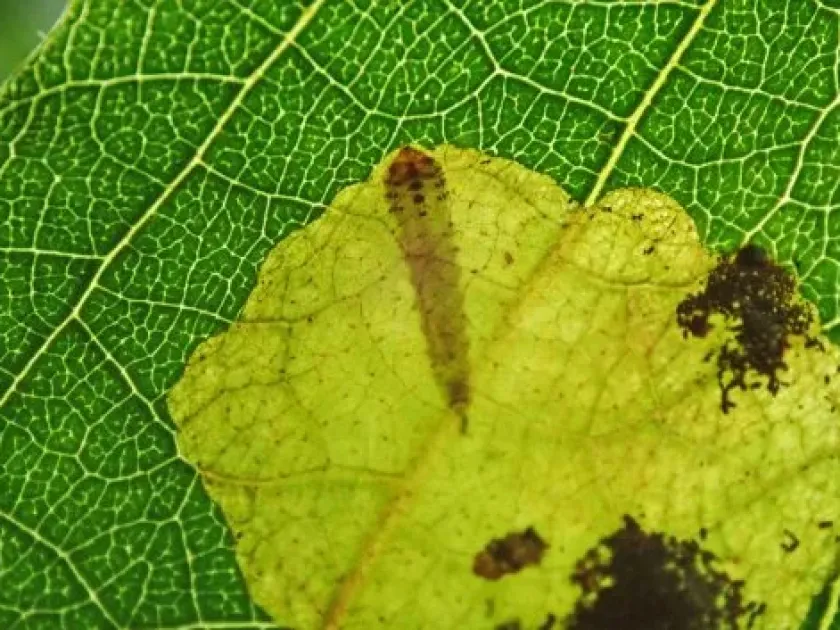
Larvae feed on the leaf parenchyma, excavating mines while leaving the upper and lower epidermis intact. This feeding behavior significantly compromises the leaf's structural integrity.
Heavy infestations can lead to premature browning and shedding of foliage, which reduces the tree's total photosynthetic capacity and overall vigor.
Continuous damage over successive years can stunt the growth of young trees and increase their susceptibility to secondary fungal infections or other environmental stressors.
In ornamental settings, the visual damage caused by mining makes the trees appear unhealthy, which is a major concern for park management and urban forestry.
Signs of infestation
The most distinct sign of infestation is the presence of blotch-shaped mines on the leaves. These mines are initially translucent and become brown as the larvae mature.
Examining the leaf against light often reveals the presence of the larva or dark fecal deposits (frass) accumulated inside the excavated mine area.
Over time, the affected areas of the leaf may dry out and crack, resulting in the development of ragged holes that affect the appearance of the entire canopy.
A high density of larvae causes mass browning of the foliage, giving the tree a scorched appearance long before the natural onset of the autumn season.
Careful inspection of the foliage during the early spring can reveal microscopic punctures, which are the oviposition sites created by female sawflies.
Control measures
Sanitation is a critical control measure: gathering and disposing of fallen leaves in autumn helps remove the overwintering generation of the pest from the site.
Systemic insecticides are generally the most effective chemical control, as they can reach the larvae protected within the leaf mines through plant sap transport.
Application timing is crucial; treatments should be performed during the peak period of egg-laying or when early-stage larvae are actively feeding.
Encouraging natural predators, such as parasitoid wasps that hunt sawfly larvae, is an excellent long-term strategy for maintaining low pest population levels.
Maintaining high forest and tree health through proper fertilization and watering helps trees withstand minor levels of infestation without significant long-term harm.
Taxonomy
- Latin name
- Heterarthrus vagans
- Order
- Hymenoptera
- Family
- Tenthredinidae
- EPPO code
- HETAVA
Discussion
No discussions yet — be the first.