
Alder leaf miner
Heterarthrus nemoratus
Description
How to identify
The Alder leaf miner Heterarthrus nemoratus belongs to the Tenthredinidae family within the order Hymenoptera.
The adult insect is a small, dark, shiny sawfly, typically reaching 3–4 mm in length, often remaining unnoticed due to its size.
The larval stage is the primary cause of plant damage, characterized by a flattened, whitish body reaching up to 8 mm.
These larvae are specialized miners that live and feed exclusively within the parenchyma layers of the alder leaf.
The pupal stage occurs inside a sturdy, disc-shaped cocoon crafted by the larva within the leaf mine, providing excellent protection against the elements.
What it damages
This pest specifically targets alder species, primarily the Grey Alder Alnus incana and the Black Alder Alnus glutinosa.
Larval feeding destroys the inner green tissues of the leaf, which results in the loss of photosynthetic capacity for the tree.
Severe infestations lead to premature leaf drop, which significantly weakens the trees and impacts their overall health and vigor.
In ornamental urban settings, the aesthetic value of the trees is often severely compromised by the widespread browning of the canopy.
Repeated annual damage can stunt the tree's growth rate and make it more susceptible to opportunistic diseases and environmental stress.
When it appears
The life cycle is generally univoltine, meaning there is one generation produced per year with peak activity in early summer.
Adults emerge in the spring, coinciding with the rapid development of young leaves, which serve as the substrate for egg-laying.
Females insert individual eggs into the leaf tissue near the veins using a specialized ovipositor to ensure proper development.
Larvae feed continuously within the leaves, creating ever-expanding blotch-like mines throughout the summer months.
By late summer, the larvae have completed their development and remain in their cocoons within the leaf litter throughout the winter.
Signs of infestation
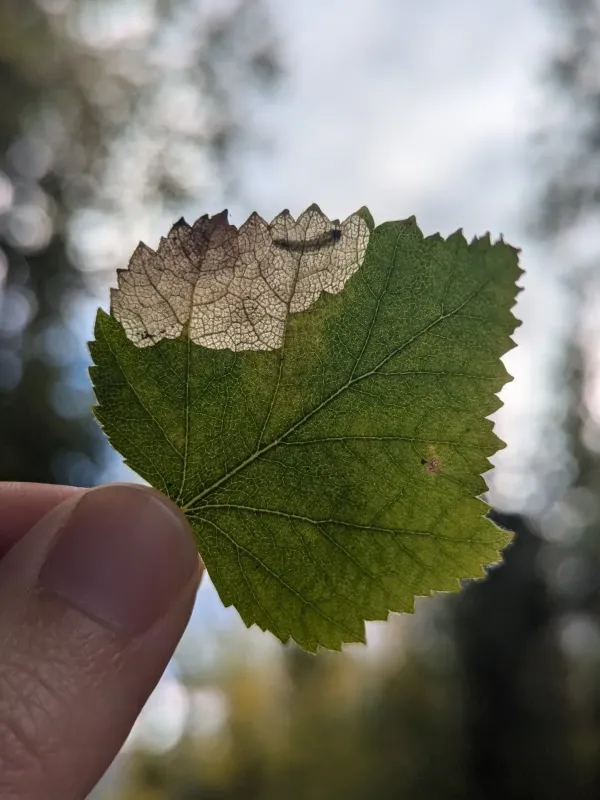
The most visible symptom is the appearance of blotch mines on the leaves, which initially look like pale spots and later turn brown.
When held against the light, the tunnels inside the leaf blade become clearly visible, often containing dark spots of larval frass.
Affected leaves may show signs of curling, distortion, and localized necrosis as the inner tissue is consumed by the miner.
High infestation levels create a characteristic scorched appearance of the entire tree canopy during the summer season.
Premature leaf drop occurring before the autumn season is a strong indicator of heavy pest pressure during the growing period.
Control measures
Sanitation is the most effective cultural control: raking and destroying fallen leaves in the autumn removes the overwintering population.
Systemic insecticides can be applied to nursery or high-value trees to target the larvae while they are still feeding inside the foliage.
Effective management requires precise timing to ensure treatments are applied before the larvae have caused widespread damage.
Encouraging natural predators such as parasitic wasps and insectivorous birds can help keep population levels below the economic threshold.
Regular visual inspections of alder stands in early summer allow for early detection and rapid response to emerging infestations.
Taxonomy
- Latin name
- Heterarthrus nemoratus
- Order
- Hymenoptera
- Family
- Tenthredinidae
- EPPO code
- HETANE
Discussion
No discussions yet — be the first.