
Maple leaf miner
Heterarthrus aceris
Description
How to identify
The maple leaf miner (Heterarthrus aceris) is a species of sawfly belonging to the family Tenthredinidae. Adult insects are small, dark-colored, and typically active during the spring season.
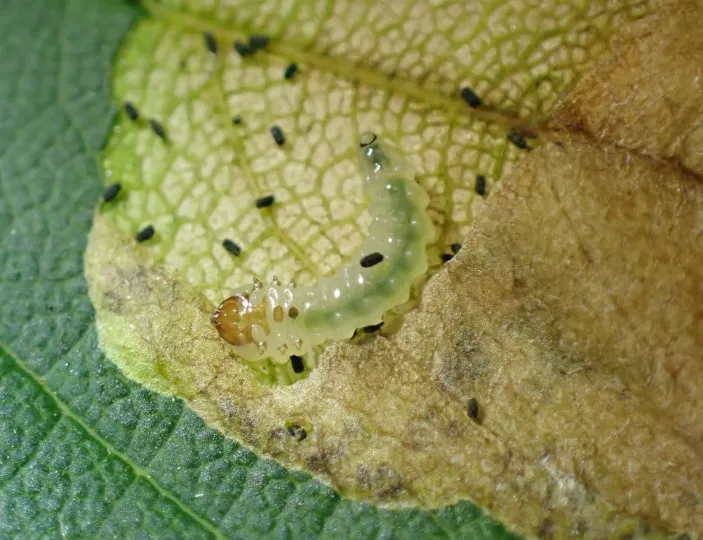
The larvae are specialized leaf miners with flattened bodies, adapted to live and feed entirely within the tissue of maple leaves, safe from most surface predators.
The life cycle undergoes complete metamorphosis, including egg, larval, pupal, and adult stages. Depending on local climatic conditions, the insect can complete one or more generations annually.
Winter survival occurs at the prepupal stage inside sturdy cocoons. These are cleverly constructed by the larvae within the leaves themselves before they fall to the ground.
Adult emergence is synchronized with the spring leaf development of maple trees, ensuring that the next generation of larvae has an immediate food source available upon hatching.
What it damages
This pest exclusively targets maple trees, particularly the Norway maple and its various ornamental varieties often used in urban landscaping and parks.
The larvae feed on the internal parenchyma of the leaves. This feeding process results in the creation of characteristic blotch-shaped mines that compromise the integrity of the foliage.
While a single mine might appear insignificant, heavy infestations can lead to substantial leaf area loss, severely affecting the tree's overall photosynthetic capacity.
Trees subjected to repeated annual attacks often show signs of reduced vigor, leading to stunted growth and increased susceptibility to secondary stressors.
The cosmetic damage is a major concern for property owners and landscapers, as it turns vibrant green canopies into withered, patchy-looking structures.
Signs of infestation
Initial symptoms include pale, semi-transparent patches appearing on the leaves. These patches represent the expansion of the larval mine as the insect grows.
Within these mines, tiny dark granules of excrement are often visible, which help distinguish insect activity from various leaf-spotting fungal pathogens.
If you hold an infested leaf up to the light, the larva is usually visible within the mine. As the larva matures, the damaged tissue may turn brown, dry out, and eventually crumble.
In autumn, look for circular cut-outs in fallen leaves. These are the specific cocoons where the larvae pupate, serving as a sign of the population size for the next season.
Premature leaf drop in mid-summer is a clear indicator that the tree is under heavy pressure from the leaf miner population.
Control measures
Sanitation is the most effective management strategy; raking and destroying fallen leaves in autumn removes the overwintering generation from the environment.
Tilling the soil under the tree canopy in late autumn or early spring can expose the cocoons to predators and harsh weather conditions, significantly reducing the survival rate.
When infestation levels are high, systemic insecticides are the preferred treatment as they are absorbed by the leaf tissues and effectively target the hidden larvae.
Application timing is critical; treatments should be performed early in the season when the first signs of mines appear to stop the development cycle before maturity.
- Monitoring for adult sawflies in early spring
- Pruning severely infested branches in private gardens
- Promoting natural enemies like parasitic wasps and predatory birds
Taxonomy
- Latin name
- Heterarthrus aceris
- Order
- Hymenoptera
- Family
- Tenthredinidae
- EPPO code
- HETAAC
Discussion
No discussions yet — be the first.