
Alder sawfly
Hemichroa crocea
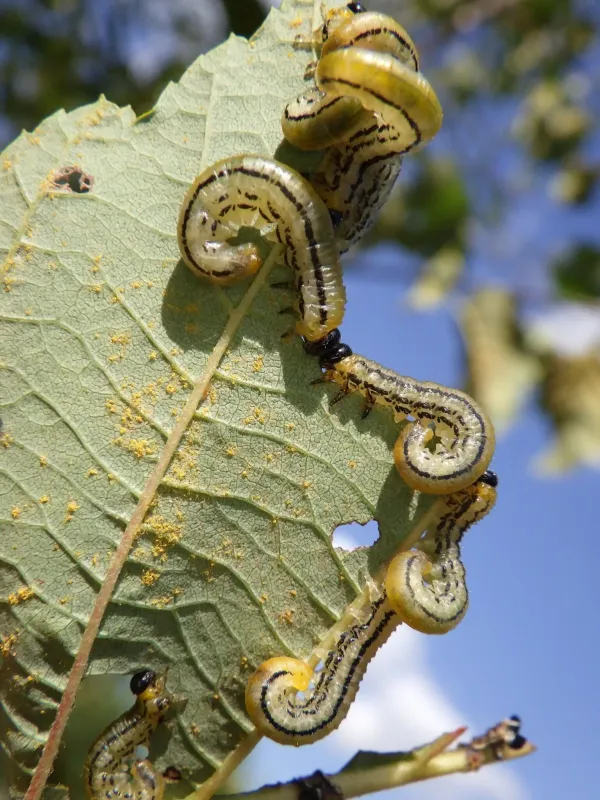
Description
How to identify
The adult alder sawfly belongs to the Tenthredinidae family. The female is characterized by a yellowish-brown abdomen, which makes it distinct among other sawfly species.
The larvae, known as false caterpillars, are typically pale green in their early stages. As they mature, they develop yellowish spots and a dark head, which is a key identification feature.
These insects undergo a complete metamorphosis. The adults are relatively small, usually measuring between 7 to 9 mm in length, and are typically active during sunny periods.
The pupal stage occurs within dense cocoons. These cocoons are cleverly hidden in the leaf litter or crevices of the bark, providing shelter from environmental stressors and predators.
Observing the larvae grouped on the underside of leaves is the most common way to identify an active population during the growing season.
What it damages
The primary host for this pest is the alder tree (Alnus spp.). In some cases, birch trees are also affected, making this sawfly a threat to various deciduous forest components.
The larvae feed on leaf tissue, starting from the edges and working their way inward. They skeletonize the leaves, consuming everything except the main leaf veins.
Severe infestations can lead to significant defoliation of the trees. This loss of foliage negatively impacts the tree's health, reducing its annual growth and overall vigor.
Repeated attacks over several seasons can weaken the tree, making it susceptible to secondary infections from fungi or other pests that exploit stressed vegetation.
In ornamental settings, the visual damage is significant, as the skeletonized leaves detract from the tree's natural beauty and aesthetic appeal.
When it appears
Adult sawflies emerge in late spring, which coincides with the full leaf development of the alder. This timing ensures that food is available for the hatching larvae.
The first generation of larvae appears in early summer, typically in June. Depending on the local climate and temperature, there can be one or two generations per year.
The larval development phase lasts for about three to four weeks. After this period, they descend to the ground to pupate in the soil or leaf litter.
Winter is spent as a prepupa inside the cocoon. This survival mechanism allows the species to withstand harsh winters and emerge promptly when conditions become favorable.
Monitoring the flight of adults and the timing of leaf emergence is crucial for forecasting when to initiate control measures for the next generation.
Signs of infestation
The primary indicator of an infestation is the appearance of lace-like leaves. Because the larvae avoid the veins, the leaves eventually look like a skeleton.
Look for the larvae clustered on the leaves. When disturbed, they often perform a characteristic curling motion of their posterior, which is a defensive behavior.
- Presence of dark frass (droppings) on the leaves and ground.
- Premature yellowing and falling of leaves during the summer.
- Visible groups of green/yellow larvae on the underside of foliage.
In high populations, the sound of larvae chewing or the presence of many adult sawflies flying around the canopy can be indicative of a heavy infestation.
Checking the bark and soil surface in the autumn may reveal the presence of overwintering cocoons, helping to estimate the potential population for the following year.
Control measures
Biological control using formulations containing Bacillus thuringiensis is effective against young larvae. This approach is environmentally friendly and preserves beneficial insects.
For chemical control, contact or systemic insecticides are applied when the larval population is at its peak. This must be timed correctly to ensure maximum impact.
Cultural practices, such as raking and destroying leaf litter in the fall, can significantly reduce the number of cocoons that survive the winter.
Encouraging natural predators, such as birds, parasitic wasps, and predatory beetles, can help keep the sawfly population below the economic injury level.
For solitary or small ornamental trees, physical removal and disposal of the larvae is a simple and effective method for small-scale infestations.
Taxonomy
- Latin name
- Hemichroa crocea
- Order
- Hymenoptera
- Family
- Tenthredinidae
- EPPO code
- HEMHCR
Discussion
No discussions yet — be the first.