
Grain thrips
Haplothrips graminis
Description
How to identify
The grain thrips (Haplothrips graminis) belongs to the order Thysanoptera and the family Phlaeothripidae. These small insects typically measure between 1.5 and 2.5 mm in length and possess dark brown or black bodies.
Adults have characteristic fringed wings, which is a defining feature of the Thysanoptera order. Their piercing-sucking mouthparts are designed to penetrate plant tissues and extract vital fluids.
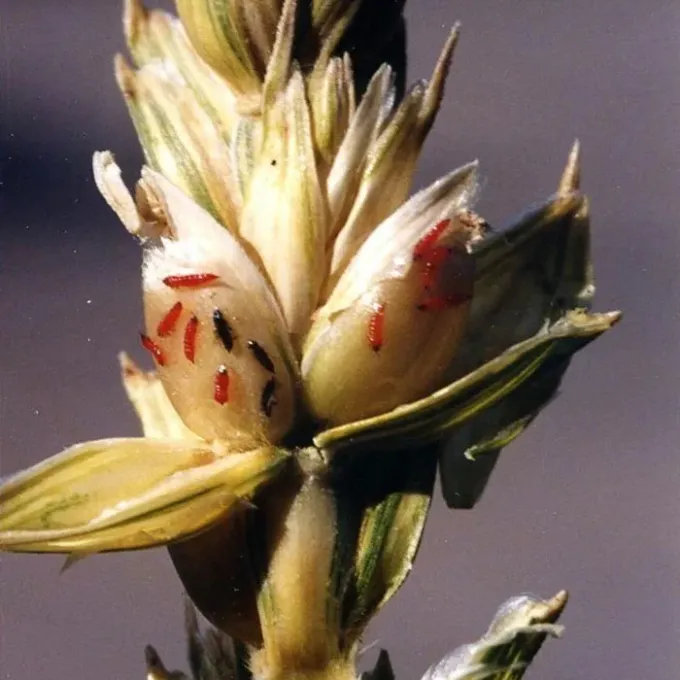
Larvae are easily distinguished by their vibrant red or orange coloration. The insect's life cycle consists of egg, larva, prepupa, pupa, and adult stages, often completed in synchronization with crop growth.
Overwintering occurs as adults, typically hiding in soil, crop residues, or perennial grasses. When spring temperatures reach 8-10°C, the adults emerge to migrate toward developing cereal fields.
The female lays eggs in clusters on host plants, primarily on stems and within the ears of grain, ensuring that emerging larvae have immediate access to nutrients.
What it damages
The primary hosts for grain thrips include wheat, rye, barley, and oats. These pests target the ears of cereals during the crucial stages of head formation and grain filling.
Both adults and larvae cause damage by sucking sap from the glumes, lemmas, and developing grains. This process disrupts the plant's nutritional supply, causing the affected parts to wither.
Severe infestations lead to "whitehead" symptoms, where parts of the ear lose their color and fail to develop properly. This results in significant yield reduction and poor grain quality.
The loss of grain weight and seed viability is a direct consequence of larval feeding. In addition, the punctures made by thrips can act as entry points for various fungal and viral pathogens.
Economic losses are usually highest when the infestation coincides with the flowering stage, as the damage directly interferes with the pollination and fertilization process of the cereal crop.
When it appears
Adult grain thrips typically emerge from winter dormancy during the stem elongation or early booting phase of the host plants. This migration phase is critical for early crop monitoring.
The highest population density of larvae usually occurs during the flowering and grain-filling stages. During this time, they settle deep within the ears, making them harder to detect.
Under favorable weather conditions, particularly warm and dry springs, the population can expand rapidly. Most regions experience one major generation of this pest annually.
As the cereal crop reaches the wax maturity stage, adult thrips gradually migrate away from the ears toward overwintering sites or late-maturing grasses.
Predicting the pest's activity is crucial, as timing the application of control measures during the initial infestation phase is key to preventing widespread crop damage.
Signs of infestation
Visual identification of an infestation starts with the observation of patchy, bleached, or white ears within a green field. This symptom is often referred to as "whitehead" damage.
Closer examination reveals the presence of adult insects and clusters of red larvae within the ear structure. The feeding activity often leaves the glumes slightly darkened or withered.
- Presence of black adult insects on the ears.
- Clusters of red larvae hidden within spikelets.
- Premature bleaching or yellowing of the grain ears.
- Significant shriveling of kernels at harvest.
- General reduction in crop vigor and plant height.
Monitoring involves shaking the ears over a white sheet to count the number of insects present. This helps agronomists estimate the infestation level and decide on further actions.
The economic threshold, usually around 10-15 larvae per ear during flowering, is the standard marker for initiating chemical intervention to prevent significant yield loss.
Control measures
Effective management begins with crop rotation, which breaks the pest's life cycle. Avoiding the proximity of winter and spring cereal crops is also an important preventative measure.
Tillage practices, specifically deep plowing after harvest, are highly effective in burying crop residues and reducing the overwintering population of the thrips.
Chemical control involving systemic or contact insecticides is applied when the pest population exceeds the economic threshold. Timing these applications correctly is essential for success.
Weed management on field borders is crucial, as many wild grasses serve as reservoirs for grain thrips, facilitating their migration into cereal crops during the growing season.
Selecting resilient crop varieties and ensuring balanced fertilization can help plants withstand stress and complete critical growth stages before the population peaks.
Taxonomy
- Latin name
- Haplothrips graminis
- Order
- Thrips
- Family
- Phlaeothripidae
- EPPO code
- HAPLGR
Discussion
No discussions yet — be the first.