
Saddle gall midge
Haplodiplosis marginata
Description
How to identify
The saddle gall midge belongs to the order Diptera and the family Cecidomyiidae. The adult insect is a small gnat about 3–4 mm long with a dark body and transparent wings.
The head of the pest is equipped with long antennae, which are more pronounced in males. A characteristic feature of the imago is the specific coloring and body shape, allowing them to move quickly within grain crops.
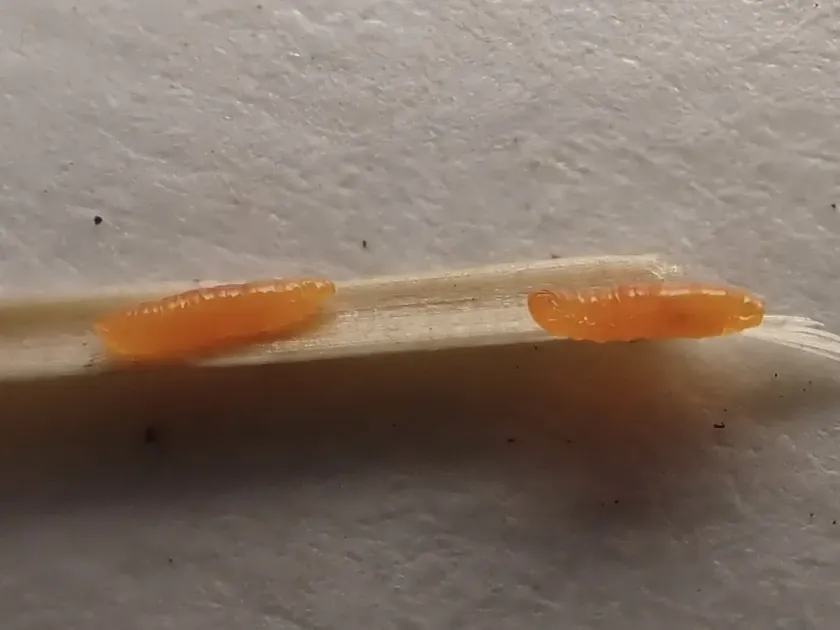
The larva of the gall midge reaches 4–5 mm in length and has a bright red or orange color. It is legless and headless, with a spindle-shaped body that facilitates movement under the leaf sheaths.
In the life cycle of this insect, one generation per year is clearly observed. Older larvae hibernate in the soil or crop residues, staying in cocoons at a depth of up to 10–15 cm.
In the spring, when favorable temperatures and sufficient humidity occur, the larvae pupate. The pupation process usually coincides with the stem elongation phase of winter cereals.
What it damages
The primary hosts for this pest are cereal crops. The saddle gall midge causes the most damage to wheat, barley, and rye fields.
In rare cases, the insect can infest oats or wild grasses if they grow in the immediate vicinity of the main agricultural fields.
The severity of the damage is determined by the mass egg-laying during the tillering and stem elongation phases. At this moment, young larvae begin to feed actively on stem juices.
Damage occurs on the stems where larvae suck nutrients from tissues. This leads to a disruption of the normal metabolic processes within the host plant.
The level of yield loss can be catastrophic at high pest densities, as mass damage leads to reduced grain weight and shriveled ears.
When it appears
Adult flight usually begins in May when the average daily air temperature reaches 15–18 degrees Celsius. This period often coincides with the beginning of the stem elongation stage of winter crops.
Females lay eggs on the upper side of cereal leaves. The fecundity of one female can be up to 100 eggs, which she places in groups along the leaf veins.
Embryonic development of the eggs lasts from one to two weeks, depending on weather conditions. Humidity plays an important role in egg survival.
After hatching, the larvae migrate under the leaf sheath, where they continue to feed. This process lasts until the plant matures, after which the larvae move into the soil.
Larvae spend summer and autumn in diapause in the topsoil layer, waiting for the next spring season to restart the life cycle.
Signs of infestation
The first sign of infestation is the appearance of characteristic swellings or saddle-shaped depressions on the stems of cereal plants, which occur at the feeding sites of the larvae.
In areas where larvae congregate, the stem becomes brittle, often bending or breaking under the influence of wind. Normal nutrient transport is disrupted.
When inspecting fields, one can notice the presence of bright red larvae under the leaf. Affected plant parts take on a chlorotic hue, gradually yellowing and drying out.
Reduced productivity of the plant is manifested by underdeveloped ears. The kernels become shriveled, and the grain does not fill, significantly lowering the quality of the commercial yield.
In severe cases, localized lodging of crops can be observed in the field, which is clearly visible when inspecting the field edges or areas with high soil moisture.
Control measures
Agrotechnical measures include strict adherence to crop rotation, which excludes growing cereal crops in the same field for more than two consecutive years.
Deep autumn plowing of the soil contributes to the death of the hibernating larval population by exposing them to the surface or burying the cocoons deep underground.
Applying early sowing dates for spring crops and optimally late ones for winter crops allows farmers to avoid mass colonization of the fields by the gall midge during vulnerable development phases.
- Use of resistant cereal crop varieties.
- Timely control of weed vegetation.
- Application of insecticides during the peak period of adult flight.
- Application of balanced fertilizers to strengthen plant immunity.
Chemical protection should be based on monitoring the number of pests using yellow sticky traps, which allows for precise determination of the timing for insecticide treatments.
Taxonomy
- Latin name
- Haplodiplosis marginata
- Order
- Diptera (flies)
- Family
- Cecidomyiidae
- EPPO code
- HAPDMA
Discussion
No discussions yet — be the first.