
Saddle gall midge
Haplodiplosis
Description
How to identify
The saddle gall midge (Haplodiplosis equestris) belongs to the order Diptera and the family Cecidomyiidae. The adult is a small midge, reaching up to 4 mm in length, characterized by a dark body and transparent wings.
Females possess a larger abdomen filled with eggs, while males have a slimmer build. They have long, thread-like antennae, which is a common trait for members of this family.
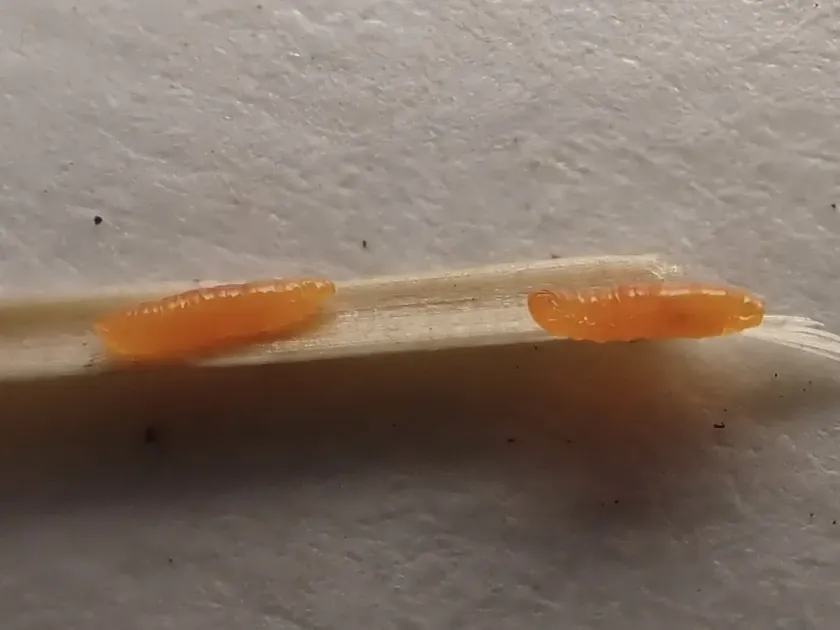
The larvae exhibit a distinct spindle-like body shape, growing to about 3–5 mm long. Their color ranges from bright orange to deep red, making them easily identifiable upon inspection of plant stems.
The species undergoes a life cycle consisting of egg, larva, pupa, and adult stages. Larvae typically overwinter in the soil or in crop residues, ensuring survival through harsh winter conditions.
Pupation occurs in the spring, after which adult midges emerge to mate and lay eggs on developing cereal crops.
What it damages
This pest primarily targets cereal crops, especially spring and winter wheat, as well as barley. To a lesser extent, rye, oats, and certain wild grasses can also be affected.
Larvae feed by sucking sap from the plant stems, positioning themselves beneath the leaf sheaths. Their feeding sites trigger pathological changes in the host plant tissues.
Mass infestations can result in significant yield losses. High populations of the midge reduce the plant's resistance to lodging, which complicates mechanical harvesting operations.
The productivity of the ear is reduced due to the disruption of nutrient transport within the stem, leading to shriveled grains and a decrease in overall crop quality.
The economic threshold for this pest depends on the region and the crop growth stage, requiring consistent phytosanitary monitoring during the growing season.
When it appears
Adult emergence typically occurs in late spring or early summer, coinciding with the plant's stem elongation phase. Weather conditions play a critical role in the activity of these insects.
Females lay eggs in clusters on the leaves and stems of cereals. Embryonic development lasts about 7–10 days, after which the newly emerged larvae migrate under the leaf sheaths.
The larval feeding period lasts approximately 3–4 weeks, during which they actively consume plant sap, causing the formation of galls—the characteristic "saddles" on the stems.
After feeding, the larvae either enter the soil for diapause until the next season or pupate if conditions allow for the development of a second generation.
The most severe damage is caused during the stem elongation stage, as the stem is most vulnerable to the phytotoxins secreted by the larvae during this period.
Signs of infestation
The most distinctive sign of infestation is the formation of specific saddle-shaped swellings on the stem, which is the source of the insect's common name.
At the site of larval feeding, the stem tissues become deformed, brittle, and often change color to yellowish-brown. In severe cases, the stems may appear distorted.
Infected plants often show stunted growth and signs of general stress. Careful examination reveals the presence of red larvae hidden beneath the leaf sheaths.
- Lodging of the crop during early ripening stages.
- Multiple swellings visible on internodes.
- Reduction in thousand-grain weight.
- Yellowing and premature drying of leaves around the feeding sites.
In the field, affected areas appear as patches of thinned or lodged crop, requiring immediate scouting and management actions.
Control measures
A primary control strategy is the implementation of crop rotation, specifically avoiding planting cereals in the same field for consecutive years.
Agrotechnical methods include deep autumn plowing, which hinders the emergence of adults from the soil and contributes to the destruction of pupae located in the topsoil layer.
Chemical control should be applied during the period of mass adult flight and the onset of egg-laying. Systemic insecticides from organophosphate or pyrethroid classes are commonly used.
The use of resistant cereal varieties with thicker, tougher stems is an effective long-term strategy, as it makes feeding significantly more difficult for the larvae.
Biological control relies on the protection of natural enemies, such as parasitic wasps, which play a significant role in suppressing midge populations in the environment.
Taxonomy
- Latin name
- Haplodiplosis
- Order
- Diptera (flies)
- Family
- Cecidomyiidae
- EPPO code
- HAPDSP
Discussion
No discussions yet — be the first.