
Sea skater
Halobates sericeus
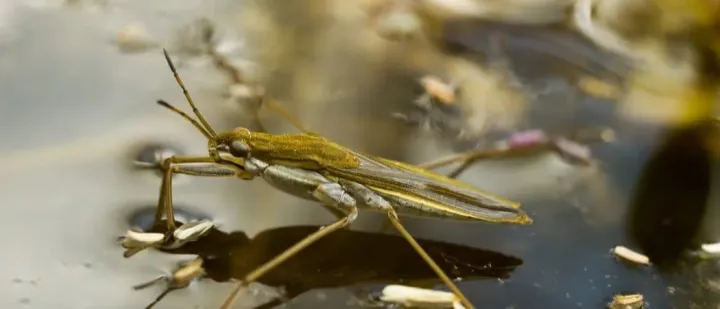
Description
How to identify
The sea skater, scientifically known as Halobates sericeus, belongs to the Gerridae family within the order Hemiptera. These insects are unique among their relatives because they live exclusively on the surface of the open ocean.
They possess a small, oval-shaped body measuring approximately 5 mm in length. Their bodies are covered in dense, microscopic hairs that are hydrophobic, allowing them to remain afloat and dry despite the constant contact with seawater.
Locomotion is achieved through long, thin legs that act as oars. This allows them to skate across the water surface at high speeds, making them efficient hunters in the vast oceanic environment.
Unlike most insects, sea skaters are wingless. Since they do not have a need for flight in the open sea, their energy is diverted towards specialized sensory mechanisms for detecting surface vibrations.
These insects are strictly predatory. They feed on various small planktonic organisms, fish eggs, and other small marine invertebrates that float on the sea surface, capturing them with their raptorial front legs.
When it appears
The reproductive cycle of the sea skater is highly dependent on available floating substrate. Females require solid objects, such as floating seaweed, driftwood, or even marine plastic debris, to deposit their eggs.
The life cycle consists of an egg stage, five distinct larval instars, and the adult stage. The larvae look like miniature versions of the adults and actively feed on the same surface-level prey.
Population density is often correlated with the presence of surface debris in the ocean. Oceanic currents act as a distribution mechanism, carrying both the insects and their egg-laden debris across vast distances.
Warmer sea temperatures generally accelerate the development of larvae. In tropical and subtropical regions, reproduction can occur continuously throughout the year, provided there is enough food.
The survival of the species relies on their ability to remain on the surface tension of the water. Their high sensitivity to surface ripples helps them avoid predators and locate potential mates in the open expanse of the ocean.
Taxonomy
- Latin name
- Halobates sericeus
- Order
- Hemiptera (bugs, aphids, leafhoppers)
- Family
- Gerridae
- EPPO code
- HALBSE
Discussion
No discussions yet — be the first.