
Water strider
Gerris
Description
How to identify
The water strider (Gerris) belongs to the order Hemiptera and the family Gerridae. These insects are perfectly adapted to life on the surface tension of water.
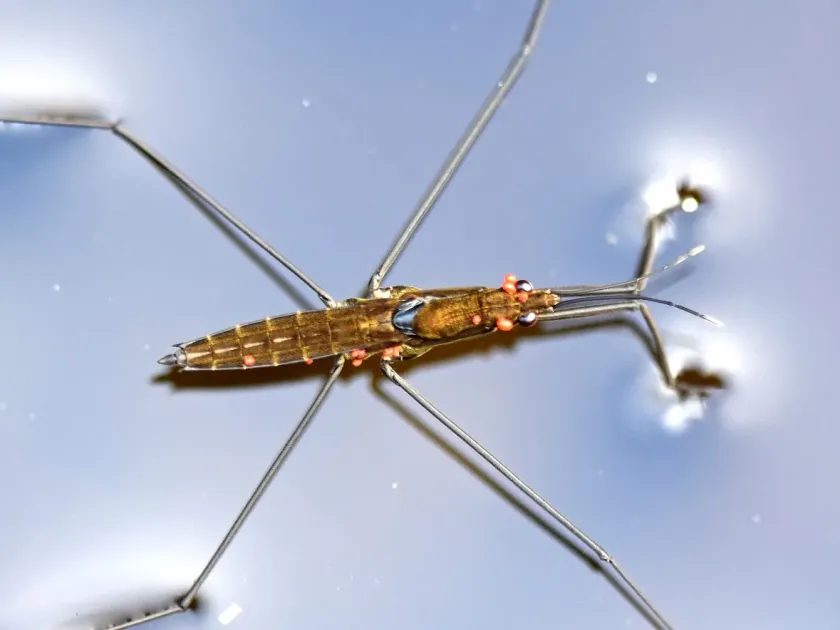
Their bodies are slender and covered with tiny, water-repellent hairs, which help them stay dry while moving across the water surface.
The most distinctive feature is their long, thin middle and hind legs, which act as supports to distribute their weight evenly across the surface.
They possess a piercing-sucking mouthpart, which is evolved for capturing prey and consuming body fluids from small insects.
Water striders have highly sensitive sensors on their legs that detect vibrations on the water, allowing them to pinpoint the location of their prey instantly.
What it damages
Water striders are not considered agricultural pests. They are predatory insects that live exclusively on the surface of freshwater bodies.
Their diet consists primarily of small insects that fall onto the water, such as mosquitoes, which makes them beneficial in controlling pest populations near water.
They do not feed on plant tissues, such as leaves, stems, or roots, and therefore cause no damage to agricultural crops or garden plants.
There is no economic harm associated with their presence; they do not impact crop yields or plant health in any way.
As they are not pests, there is no need for farmers or gardeners to take any protective measures against them in the field.
When it appears
The seasonal activity of water striders depends on the availability of open water and ambient temperatures throughout the year.
They typically overwinter as adults, seeking refuge in protected terrestrial habitats such as leaf litter, bark, or crevices near the water's edge.
In spring, as temperatures rise, they emerge from their hibernation sites and move onto water surfaces to mate and lay eggs.
The summer months represent the peak of their activity, as new generations grow and hunt on ponds, streams, and irrigation ditches.
As autumn temperatures drop, water striders prepare for winter by moving to their hibernation shelters to survive the cold months.
Control measures
Since water striders are not pests, there are no established control methods for them in agricultural or horticultural practice.
The use of insecticides to control these insects is strictly discouraged, as it can cause significant harm to the aquatic ecosystem and beneficial wildlife.
If their presence is undesired in a man-made garden pond, increasing water turbulence, such as through a fountain, will naturally deter them.
Maintaining a balanced ecosystem encourages natural predators, which keeps the population of water striders stable and within natural limits.
No agricultural intervention is required, and they should be viewed as a normal and harmless component of a healthy environment.
Taxonomy
- Latin name
- Gerris
- Order
- Hemiptera (bugs, aphids, leafhoppers)
- Family
- Gerridae
- EPPO code
- GRRISP
Discussion
No discussions yet — be the first.