
Halobates hawaiiensis
Halobates hawaiiensis
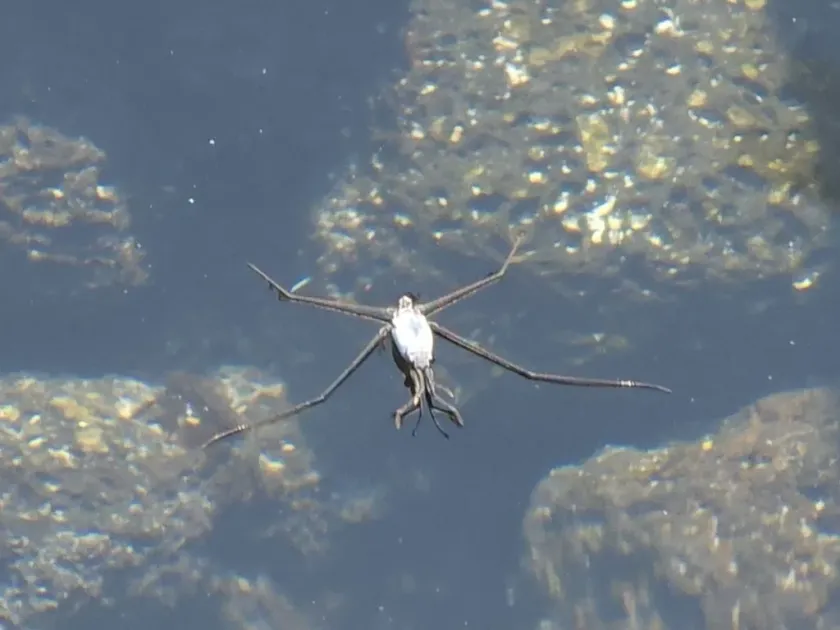
Description
How to identify
Halobates hawaiiensis is a fascinating member of the Gerridae family, commonly known as sea skaters, belonging to the order Hemiptera.
Unlike its terrestrial or freshwater relatives, this species has completely adapted to life on the surface of the open ocean.
The insect features a compact, dark-colored body and long, hydrophobic legs that allow it to remain afloat and move rapidly across the water surface.
These insects are highly specialized for their marine environment and lack wings, relying entirely on their ability to glide on the water's surface film.
They are classified as part of the neuston community, living at the very interface between the ocean surface and the atmosphere.
What it damages
It is crucial for agricultural professionals to know that Halobates hawaiiensis does not feed on plants and is not an agricultural pest.
The species is predatory, feeding exclusively on small marine organisms, larvae, and plankton found in the surface layer of the ocean.
There is no intersection between the ecological niche of this insect and any terrestrial or aquatic crops grown for commercial purposes.
Consequently, it causes no economic damage to farming, horticulture, or forestry, as its habitat remains far removed from human cultivated landscapes.
Reports labeling this species as a pest are misinformed, as its entire life history is spent thousands of kilometers away from crop fields.
When it appears
The lifecycle of Halobates hawaiiensis is not influenced by seasonal farming schedules or temperature fluctuations typical of land-based agriculture.
In tropical environments, reproduction occurs year-round as long as oceanic conditions remain stable and conducive to surface-dwelling.
Populations tend to remain steady, though they may migrate based on changes in ocean currents and the availability of surface debris for oviposition.
Young nymphs go through several developmental stages directly on the water, gradually reaching maturity without leaving their marine habitat.
Seasonal patterns in the open ocean are more related to water temperature and nutrient upwelling rather than the solar seasons that dictate terrestrial farming.
Signs of infestation
Identification in the wild is possible only through direct observation of the ocean surface in specific tropical regions where they are known to thrive.
Signs of their presence include the sight of small, agile black specks rapidly moving across the water's surface during calm weather conditions.
Researchers often look for eggs attached to floating objects, such as sea-drifted plastic or organic debris, which the insects use as substrate.
As they do not infest vegetation, there are no leaf spots, necrotic tissues, or other symptoms associated with their presence on plants.
Scientific monitoring involves specialized surface-trawl nets designed to catch neustonic organisms from the top few centimeters of the water column.
Control measures
No pest control or plant protection measures are required or recommended for this species, as it poses no threat to any agricultural commodities.
The use of insecticides in marine environments is strictly prohibited and would cause severe damage to marine ecosystems.
Population management is entirely left to natural trophic interactions within the marine food web, including predation by fish and seabirds.
For individuals involved in coastal aquaculture, Halobates hawaiiensis is considered a neutral organism that does not interfere with production cycles.
No agricultural consulting or intervention is necessary for this species, as it remains a purely wild inhabitant of the open seas.
Taxonomy
- Latin name
- Halobates hawaiiensis
- Order
- Hemiptera (bugs, aphids, leafhoppers)
- Family
- Gerridae
- EPPO code
- HALBHA
Discussion
No discussions yet — be the first.