
Common crane
Grus grus
Description
How to identify
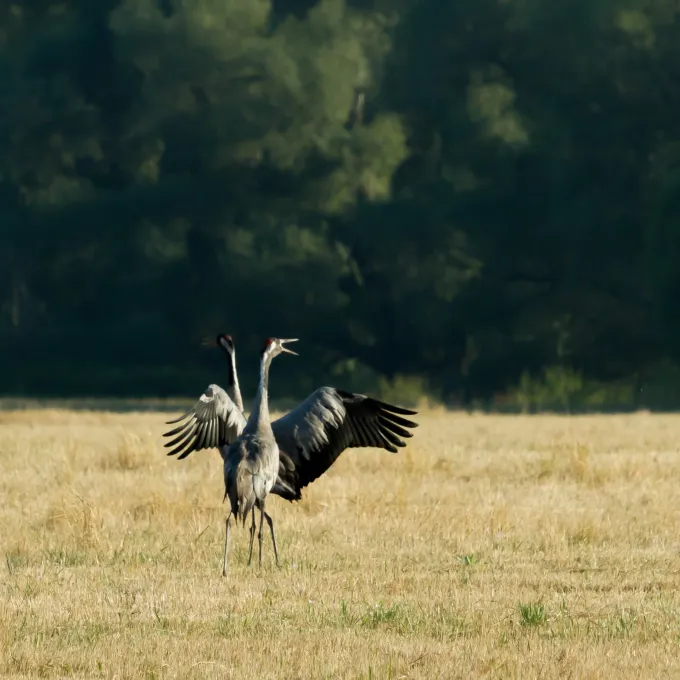
The Common crane (Grus grus) belongs to the order Gruiformes and the family Gruidae. It is a large migratory bird with a wingspan of up to 2.4 meters, characterized by grey plumage, long legs, and a long neck.
Adult birds have a distinct black throat patch and white stripes along the sides of the neck. On the crown, there is a visible patch of red skin without feathers, which is a key identification feature for the species.
Juveniles have duller, reddish-brown plumage, which only changes to adult coloration after the molting period. These birds are diurnal and gather in large flocks during migration periods.
The biology of the species involves high sociality: while foraging in fields, there are always sentinel birds that keep watch for danger. This makes the use of simple mechanical deterrents difficult.
The life cycle is tied to seasonal migrations: in spring, cranes return to breeding sites in wetland areas, and in autumn, they gather in large flocks on agricultural land before migrating south.
What it damages
Cranes are omnivorous birds, but in agroecosystems, they switch to high-energy agricultural crops. The main damage occurs during the seed germination and crop ripening stages.
Winter cereal crops suffer the most damage during the autumn period. Birds pull seeds directly from the soil immediately after sowing, destroying a significant portion of the seed material.
In spring, cranes damage emerging seedlings of spring crops, including corn, peas, and sunflowers. Young sprouts are pulled out by the roots, leading to sparse plant stands.
During the dough stage, cranes can damage corn cobs and wheat heads. Group feeding by a flock can destroy up to 30% of the yield in specific parts of a field.
Trampling of crops by adult birds also causes mechanical damage: the soil becomes compacted, and plants break, which promotes the development of secondary infections in the damaged areas.
When it appears
The main period of damage coincides with two crucial stages of agricultural operations: spring sowing and autumn harvest. This is when birds are most concentrated on farmland.
In spring, from late March to May, cranes actively search for food on newly plowed or sown fields, making them a serious risk factor for farmers.
In autumn, from late August to October, damage becomes most widespread. Flocks gather on fields during harvest or where cereal grains are left behind, preparing for their migration.
The intensity of field visits depends on weather conditions: in rainy years, birds stay longer at their stopover sites, which increases their overall impact on crops.
Intraseasonal population dynamics correlate with crop development phases: cranes focus most of their attention on fields with germinating seeds rich in nutrients.
Signs of infestation
The first sign of crane presence is the characteristic tracks on damp soil, resembling the prints of large birds with long toes, arranged linearly across the field.
The presence of mass crop thinning, where plants are missing or pulled out by the root, indicates bird activity. Unlike rodents, cranes leave bare patches of distinct shapes.
Damaged corn cobs or wheat heads have specific jagged edges. Often, shed feathers or droppings characteristic of cranes can be found near feeding sites.
Morning and evening visual observations of flocks moving between roosting sites and foraging fields serve as a direct warning of a threat to the crop.
Areas of flattened crops are often observed, resulting from the mass movement of a flock within the field while searching for food.
Control measures
Effective crop protection requires a comprehensive approach, as cranes quickly habituate to uniform deterrents. It is necessary to combine various methods to confuse the birds.
- Use of gas cannons and sound-emitting devices operating in a random mode.
- Application of visual deterrents such as raptor decoys or reflective tapes.
- Organization of 24/7 field patrols during critical plant growth stages.
- Use of seeds with protective coatings that have repellent scents or tastes.
- Ensuring rapid seed burial at depths inaccessible to crane beaks during sowing.
Taxonomy
- Latin name
- Grus grus
- Family
- Gruidae
- EPPO code
- GRUSGR
Discussion
No discussions yet — be the first.