
Sandhill crane
Grus canadensis
Description
How to identify
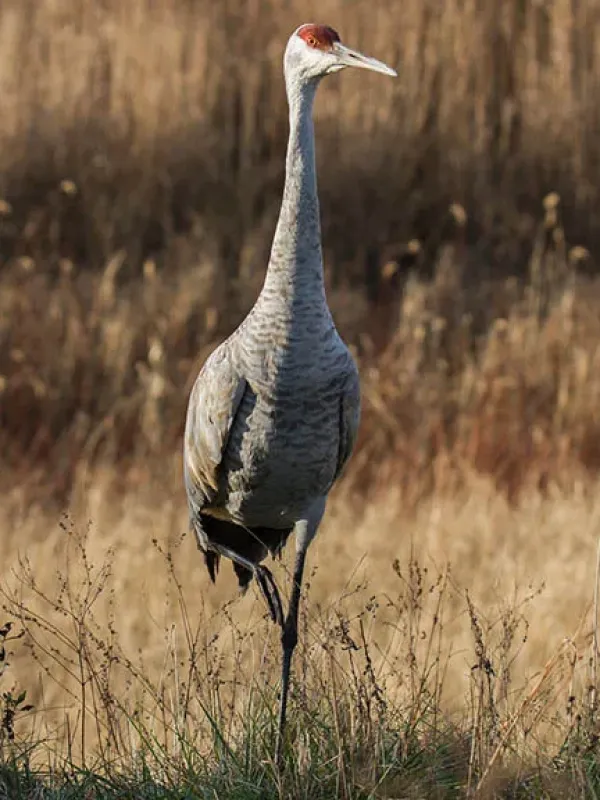
The sandhill crane (Grus canadensis) is a large migratory bird species belonging to the Gruidae family. It is characterized by its grey plumage, a prominent crimson skin patch on its forehead, and an impressive wingspan that can reach up to two meters.
This species shows high adaptability to diverse environments, including farmland areas. They are highly social birds that congregate in large flocks, which significantly increases their impact on agricultural fields during migration periods.
The biology of the species involves nesting in wetlands, but after the fledging of their chicks, flocks actively shift their foraging behavior to agricultural fields. Their high social intelligence allows them to rapidly locate food sources within agroecosystems.
Sandhill cranes possess a strong, versatile beak adapted to extracting various food items, including seeds, tubers, and small invertebrates from the soil. Adults are notoriously wary and intelligent, which complicates conventional pest control efforts.
Their life cycle involves intense preparation for migration, during which birds consume vast amounts of energy-dense food. This period often coincides with crop maturation, making them a significant economic threat to farmers.
What it damages
The primary crops affected by sandhill cranes include cereal grains such as corn, wheat, and barley. These birds are capable of destroying entire seedling populations or consuming significant portions of the crop before harvest.
Corn is particularly vulnerable during the germination stage, as cranes dig up the planted seeds directly from the soil. A large flock can cause substantial yield loss by stripping entire sections of a field in a very short time.
In addition to cereals, cranes can damage vegetable crops by uprooting young plants or consuming root crops. Their opportunistic diet allows them to switch food sources depending on availability, extending the duration of potential damage.
Soil compaction caused by large flocks congregating on the field also negatively impacts soil structure. While this is a secondary effect, it may reduce the long-term productivity and uniform growth of the field.
Economic damage is most severe in regions situated along major migratory flyways. Farmers in these areas frequently face increased costs due to the necessity of replanting fields destroyed by crane foraging.
Signs of infestation
One of the primary indicators of crane presence is the discovery of large, distinct tracks in the soil measuring 10-15 centimeters. These tracks form clear, linear paths across the field, easily identifiable by the characteristic three-toed print.
Fields infested by cranes often exhibit patches of excavated soil where seeds or tubers were extracted. Scattered plant debris, such as hulls and crushed seedling remains, is frequently found around the feeding sites.
Large accumulations of droppings on the field surface provide clear evidence of prolonged foraging or resting. These sites are easily visible during field inspections and serve as a warning of heavy bird activity.
Visual confirmation of flocks circling over fields or moving between water bodies and croplands is a strong indicator of an active feeding cycle. Cranes are most active during dawn and dusk hours while searching for food.
Damaged sections of the field often show a thinning of the stand, creating bare spots or patchy areas. These spots quickly become colonized by weeds, as the main crop has been severely suppressed or removed entirely.
Control measures
Acoustic methods, such as the use of broadcast distress calls, are widely used for short-term deterrence. These systems aim to create a high-pressure environment that encourages the flock to move to a safer location.
Visual repellents, including predator effigies and reflective materials, can be effective but require regular repositioning. Because cranes are intelligent, they often habituate to static deterrents if they are not moved frequently.
Propane cannons that simulate gunshot sounds are common in large-scale agriculture. These devices create a zone of disturbance, although their effectiveness diminishes if the birds perceive them as predictable and non-threatening.
Agrotechnical strategies often involve coating seeds with repellent substances that provide a deterrent taste or scent. This preventive measure protects the seeds during the critical germination phase before they emerge.
Modern solutions include the use of drones to actively haze and displace birds from fields. This tactical approach allows for rapid, real-time responses to crane incursions, significantly reducing crop damage without chemical intervention.
Taxonomy
- Latin name
- Grus canadensis
- Family
- Gruidae
- EPPO code
- GRUSCA
Discussion
No discussions yet — be the first.