
Chicken louse
Goniodes gigas
Description
How to identify
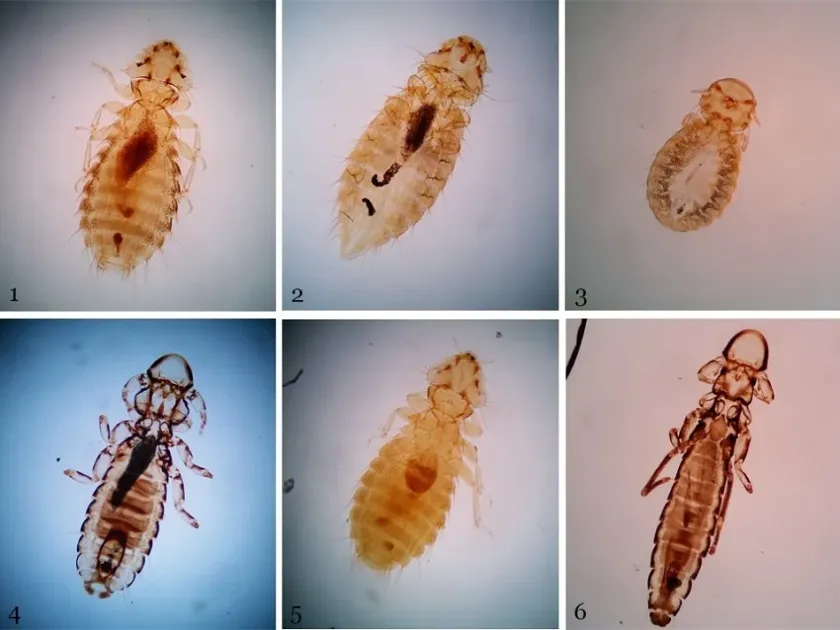
The chicken louse (Goniodes gigas) is a small, wingless insect belonging to the order Mallophaga and the family Philopteridae. This ectoparasite has a flattened, brown-colored body, typically measuring 3–4 mm in length.
Its chewing mouthparts are adapted to feed on skin debris, feather fragments, and blood or lymph exudates from small skin wounds. The louse features a broad head with characteristic structures that help it anchor firmly to the host's feathers.
The entire life cycle of this species occurs on the bird's body, progressing through egg (nit), three nymphal stages, and adult. The cycle is completed in approximately 3–4 weeks, depending on the ambient temperature and skin moisture.
The female louse lays eggs attached to the base of the feathers, commonly around the vent, under the wings, or on the breast area. The reproduction rate is high, leading to rapid population growth and widespread infestation within a flock.
Outside the host, these lice cannot survive for long, as they are obligate parasites perfectly adapted to the specific microclimate provided by the bird's plumage.
What it damages
This parasite primarily targets domestic chickens, though it may be found on other poultry species. Unlike blood-sucking mites, these lice remain on the bird at all times, causing constant irritation through their movement.
The primary damage results from irritation to the skin and structural impairment of feathers, often leading to a condition known as mallophagosis. Infested birds exhibit restless behavior, frequent preening, and reduced appetite.
Constant stress caused by the parasites results in decreased egg production and slower weight gain in growing birds. In severe cases, the bird becomes exhausted and more susceptible to secondary infections.
The plumage becomes ragged and brittle as the birds attempt to soothe the itching by over-preening or self-plucking, leading to patches of bare skin. Lesions from scratching often harbor secondary bacterial infections.
If left untreated, heavy infestations can lead to significant morbidity, particularly in young or immunocompromised birds that cannot cope with the constant nutritional and physiological stress.
Signs of infestation
Early signs of infestation include restlessness, frequent preening, and dust bathing more often than normal. Visual inspection reveals broken or ruffled flight and tail feathers.
By parting the feathers, especially near the breast, thighs, and vent, one can observe the lice moving quickly across the skin. Clusters of nits (eggs) appear as whitish, sticky masses attached to the feather shafts.
Skin irritation, characterized by redness, scratches, and scabs from lymph exudate, is often present. The overall appearance of the bird becomes unkempt, and performance markers significantly decline.
A reliable indicator is the presence of dark specks, which are the excrement of the lice, visible on the feathers when inspected under bright light.
Infestation spreads quickly throughout the flock due to close contact between birds, shared nesting boxes, and the use of common perching areas.
Control measures
Effective management requires a combination of direct treatment of the poultry and thorough disinfection of the housing environment. Various insecticides in the form of sprays, powders, or dips are utilized.
- Individual treatment of every bird in the flock with approved veterinary insecticides.
- Follow-up treatment after 7–10 days to target the newly hatched nymphs.
- Deep cleaning and disinfestation of the poultry house, including all perches and nesting boxes.
- Providing sand-ash dust baths to encourage natural pest management.
- Maintaining proper sanitary conditions and avoiding overcrowding to prevent rapid parasite transmission.
It is critical to treat all birds in the flock simultaneously to break the life cycle of the parasite and prevent re-infestation from lingering individuals or contaminated equipment.
Taxonomy
- Latin name
- Goniodes gigas
- Family
- Goniodidae
- EPPO code
- GONDGI
Discussion
No discussions yet — be the first.