
Pigeon louse
Campanulotes
Description
How to identify
The pigeon louse (lat. Campanulotes bidentatus) is a small insect of the order Phthiraptera, belonging to the Philopteridae family. The adult has a flattened body about 1.5–2 mm long, light brown or yellowish in color, making it inconspicuous on the bird's feathers.
The pest has a wide head with powerful chewing mouthparts adapted to feed on feather fragments and skin scales. Unlike fleas or mites, chewing lice spend their entire life cycle on the host's body and do not leave it under normal conditions.
Microscopy is often used to identify the species, as many louse species appear similar to the naked eye. Campanulotes is distinguished by a specific head shape and antennae structure, which are attached in special grooves.
The larvae resemble adults but are smaller and paler. They develop under the same conditions as the adults, passing through several nymphal stages before reaching sexual maturity.
Reproduction occurs year-round as long as the host's body temperature remains stable. A single female lays dozens of eggs in her lifetime, securely cementing them to the barbules of the bird's feathers.
What it damages
The hosts of this parasite are exclusively domestic and wild pigeons. This species is a highly specialized ectoparasite that does not infest other types of poultry or mammals.
The pest does not feed on blood, but its activity causes serious damage to the quality of the plumage and the bird's overall health. It chews on the feather shafts, barbs, and skin scales, causing inflammatory processes.
The greatest damage occurs when the parasite population density is high. This leads to impaired thermoregulation, decreased productivity, and a depressed state in the bird.
Constant itching forces pigeons to behave restlessly; they often preen excessively and peck at themselves to get rid of the parasites, which leads to self-mutilation and feather loss. Damaged feathers lose their protective properties, become brittle, and fall out.
In pigeon lofts, mass reproduction of lice can cause exhaustion, weakened immunity, and increased susceptibility to secondary infectious diseases.
Signs of infestation
The main sign of infestation is extreme restlessness. Pigeons constantly preen, sort through their feathers with their beaks, shake themselves frequently, and take dust baths in an attempt to mechanically remove the parasites.
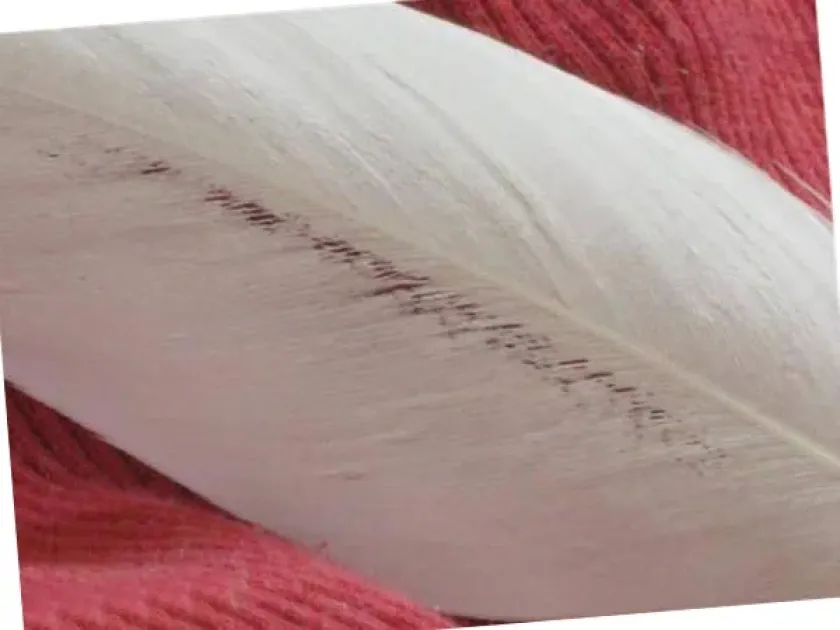
Visual inspection of the plumage, especially in the flight and tail feathers, reveals characteristic damage: frayed feather edges, holes in the feather vanes, and the presence of small, fast-moving insects on the skin when feathers are parted.
Louse eggs (nits) are easily detected at the base of the feathers as clusters of small white or transparent dots. They are firmly fixed by the female's secretion and are difficult to remove by simple shaking.
In cases of severe infestation, the plumage appears ruffled and dull. The bird's skin where parasites congregate may show signs of dermatitis, scratches, and micro-injuries caused by the host's own efforts to relieve the itching.
In the housing facilities, parasite clusters may be visible on the bedding or in the nests if the population has reached critical levels and overcrowded the host.
Control measures
Controlling the pigeon louse requires a comprehensive approach, including individual bird treatment and disinfection of their habitat. Using specialized insecticidal powders, aerosols, or spot-on drops is the most effective method.
Products based on pyrethroids or fipronil provide rapid elimination of adults and nymphs. It is important to treat all birds in the loft simultaneously to prevent re-infestation from untreated individuals.
It is essential to strictly follow the recommended treatment schedule, as most insecticides do not kill the eggs (nits). Typically, a follow-up procedure is performed after 10–14 days to kill the newly hatched generation.
Simultaneously, thorough cleaning and disinfection of the loft are required. All bedding materials must be incinerated, and nest surfaces, perches, and walls should be treated with approved disinfectants or insecticidal solutions.
Prevention involves maintaining high hygiene standards, regular health checks of the birds, and preventing contact between domestic pigeons and wild individuals, which are frequent carriers of parasitic infestations.
Taxonomy
- Latin name
- Campanulotes
- Family
- Goniodidae
- EPPO code
- CAMASP
Discussion
No discussions yet — be the first.