
Alfalfa leaf beetle
Gonioctena fornicata
Description
How to identify
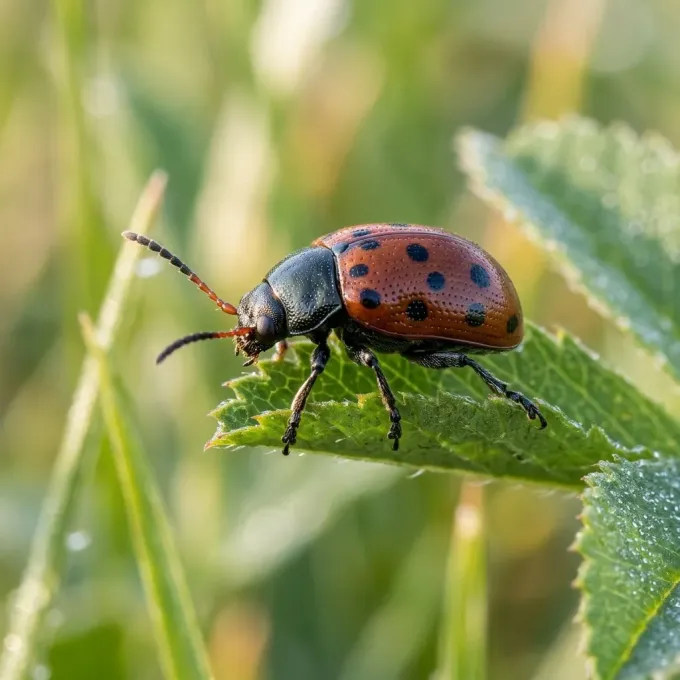
The alfalfa leaf beetle (Gonioctena fornicata) belongs to the Chrysomelidae family of the order Coleoptera. Adult beetles are characterized by a convex, oval body measuring 5–7 mm in length, typically displaying yellowish-brown or reddish-brown coloration with distinct dark patterns on the pronotum and elytra.
The larvae of this species have a plump, strongly convex body that is yellowish or dirty white. They are covered with small dark tubercles, and their well-developed, dark-colored head facilitates efficient feeding on plant tissues.
Adults overwinter in the soil or under plant debris in alfalfa fields. With the arrival of stable spring temperatures, they emerge to the surface to begin feeding on young, tender vegetation.
Reproduction involves laying eggs in batches on the underside of host plant leaves. A single female can produce several hundred eggs throughout the season, ensuring the rapid colonization of the crop.
The life cycle encompasses four main stages: egg, larva, pupa, and imago. Pupation generally occurs within the upper layers of the soil, after which the new generation of adults emerges within two weeks.
What it damages
The primary host for this pest is alfalfa, although it can occasionally infest other leguminous forage crops. During outbreaks, this beetle can cause significant damage, leading to the destruction of substantial portions of green biomass.
Larvae are responsible for the majority of the damage; they skeletonize the leaves, leaving only the primary veins intact. Adult beetles also feed on the foliage, creating irregular holes that drastically reduce the photosynthetic surface of the plant.
Infested crops often exhibit stunted growth and loss of turgor, significantly reducing their nutritional value. In severe cases, the fields may appear ragged and gray due to the complete loss of leaf mass.
The pest is most destructive during the active growth phase of the alfalfa, making the crop highly susceptible to yield losses. Damaged areas often become vulnerable to secondary pathogens and further stress.
Assessing the economic threshold is critical for managing this pest. Monitoring population density helps farmers determine when to intervene to prevent irreversible damage to the forage quality.
When it appears
Adult activity typically begins in early spring, usually between April and May, when temperatures reach approximately 12–15 degrees Celsius. This marks the initial emergence from overwintering sites.
Larval development generally coincides with the spring growth flush of the first alfalfa cut. This period is critical, as the population peaks during the most rapid vegetative growth stage.
The species usually completes one generation per year. However, if climatic conditions are favorable, a second generation may occur, extending the period of potential infestation throughout the summer months.
During the peak of summer heat, adults often enter a diapause phase, seeking refuge in the soil or under canopy cover to survive drought conditions and high temperatures.
As autumn approaches, the beetles migrate into the soil for hibernation. The success of their overwintering is highly dependent on soil moisture levels and the availability of suitable shelter within the fields.
Signs of infestation
The most prominent sign of infestation is skeletonized leaves and the presence of irregular bite marks across the foliage. Inspecting the underside of the leaves usually reveals the presence of larvae.
- Wilting of top shoots due to feeding damage.
- Noticeable reduction in the overall height of the alfalfa stand.
- Presence of beetles when sweeping the canopy with a net.
- Accumulation of larval excrement on the leaf surface.
Control measures
Timely harvesting of the alfalfa is the most effective agronomic measure, as it disrupts the life cycle by removing both food sources and larvae. Crop rotation is also essential to manage long-term populations.
Deep plowing following the final cut helps bury and destroy overwintering beetles. Additionally, maintaining field margins free of leguminous weeds reduces the pest's ability to survive and re-infest the fields.
If population levels exceed the economic threshold, systemic or contact insecticides may be applied. It is vital to use products that minimize harm to pollinators and beneficial predatory insects.
Biological control, including the conservation of natural predators, plays a key role in maintaining ecological balance. Encouraging biodiversity around the fields helps keep the beetle population under control naturally.
Continuous monitoring using traps or field counts is the best practice for informed decision-making. Integrated Pest Management (IPM) strategies ensure sustainable crop protection while reducing chemical reliance.
Taxonomy
- Latin name
- Gonioctena fornicata
- Order
- Coleoptera (beetles)
- Family
- Chrysomelidae
- EPPO code
- GONCFO
Discussion
No discussions yet — be the first.