
American leaf beetle
Gonioctena americana
Description
How to identify
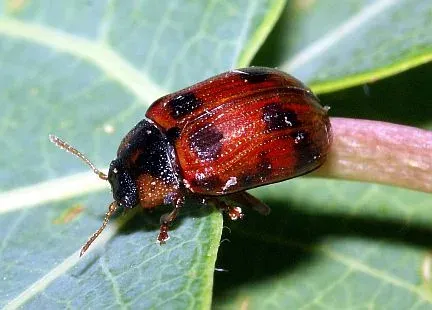
The American leaf beetle (Gonioctena americana) belongs to the Chrysomelidae family, the order Coleoptera. Adult beetles are characterized by their oval body shape, typically displaying yellow-brown or reddish hues adorned with distinct dark spots on the elytra and pronotum.
The larvae of this pest are highly active and possess a distinct appearance common to many members of this genus. They feature a convex body, often grayish or yellowish, covered in fine dark dots which serve as camouflage against the green foliage.
The insect undergoes complete metamorphosis during its life cycle, passing through egg, larval, pupal, and adult (imago) stages. Adult beetles are primarily diurnal, actively feeding on young leaf tissues.
Overwintering typically occurs as adults in the upper soil layers, leaf litter, or crevices in tree bark. As temperatures rise in the spring, beetles emerge from diapause to begin their maturation feeding.
Accurate identification involves examining the specific pattern on the elytra and the host plant species. While primarily distributed in North America, this species is recognized for its potential impact on willow and poplar populations.
What it damages
The primary hosts for the American leaf beetle are trees within the Salix (willow) genus. Less frequently, they may infest poplar trees, where they show a preference for young shoots and fresh, tender leaves.
Adult beetles consume the leaf blade, creating holes of varying sizes. They often skeletonize the foliage, consuming the tissue between veins, which significantly disrupts the tree's photosynthetic ability.
Larval feeding is equally damaging, as they often feed in groups. Under conditions of high population density, these pests can cause severe defoliation, stripping branches bare and weakening the entire tree structure.
Young nursery stock is particularly vulnerable. Extensive loss of the canopy slows growth, reduces frost resistance, and may lead to the total loss of the plant material if left unmanaged.
Furthermore, the damaged leaf tissue provides entry points for opportunistic fungal and bacterial pathogens, which can exacerbate the tree's stress and lead to secondary infections.
When it appears
The first emergence of adults occurs in mid-to-late spring, coinciding with the warming of the soil and the development of new leaves on host trees. This timing is critical for the beetles' survival and reproductive success.
Mating and oviposition occur in early summer, followed by the hatching of larvae. The peak period of larval feeding damage generally takes place throughout June and July.
Pupation typically occurs in the soil beneath the host plant, a detail that is important to consider when planning mechanical control strategies such as soil cultivation.
By late summer or early autumn, the new generation of adults seeks sheltered areas for hibernation. The number of generations per year can vary depending on the local climate and seasonal temperature profiles.
Environmental factors, particularly humidity and temperature, play a major role in population dynamics. While favorable warm weather promotes rapid development, extreme conditions may naturally regulate the pest population.
Signs of infestation
The initial sign of infestation is the appearance of small holes in the leaf surface. As the larvae grow, these holes enlarge, leading to ragged leaf margins and a transparent or lacy appearance.
Careful inspection of the leaf undersides often reveals clusters of eggs or groups of developing larvae, which tend to aggregate during the early stages of their development.
Adult beetles can be spotted during daylight inspections. A common behavioral trait is their tendency to drop from the branch or remain motionless (thanatosis) when the plant is disturbed.
The accumulation of larval excrement (frass) on the leaves and beneath the canopy is a clear indicator of active feeding and should prompt immediate investigation.
Wilted leaf edges, discolored foliage, and premature leaf drop are advanced signs of infestation that indicate the tree is suffering from significant nutritional stress.
Control measures
Mechanical removal is a viable control strategy for smaller gardens or individual nursery plants where manual picking of beetles and larvae is feasible.
Biological control agents, such as formulations containing Bacillus thuringiensis, are highly effective against larvae while being selective and environmentally friendly.
In large-scale plantings or nurseries, professional insecticide treatments may be necessary to manage outbreaks and protect the tree health from significant damage.
- Cultivating the soil around the base of the tree in autumn to disturb pupating larvae.
- Pruning and destroying heavily infested branches to reduce the pest load.
- Maintaining tree vigor through proper irrigation and fertilization to aid recovery.
Regular monitoring from early spring through the growing season is the most effective approach. Early detection allows for targeted management and minimizes the need for broader chemical intervention.
Taxonomy
- Latin name
- Gonioctena americana
- Order
- Coleoptera (beetles)
- Family
- Chrysomelidae
- EPPO code
- GONCAM
Discussion
No discussions yet — be the first.