
Pill millipede
Glomeris guttata
Description
How to identify
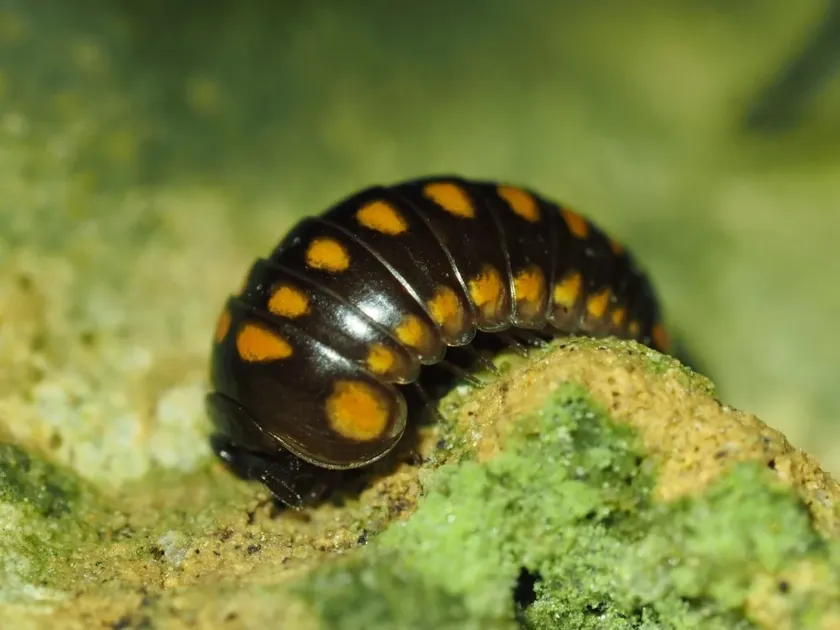
The pill millipede (Glomeris guttata) belongs to the order Glomerida, family Glomeridae. It is characterized by its convex body that can roll into a tight ball when the creature is threatened, resembling a pillbug or woodlouse.
The adult body consists of 11–12 segments, typically dark in color with distinct light or reddish spots along the sides. Individuals usually measure between 10 and 20 mm in length.
Respiration occurs through the underside of the body, making this species highly dependent on soil moisture levels. They thrive in moderately damp, shaded environments with plenty of decaying organic matter.
The life cycle involves an egg stage, several larval stages, and nymphal development. Growth is slow, and each molt is accompanied by an increase in the number of body segments.
Females lay eggs in loose, moist soil or leaf litter, often constructing protective capsules from their own excrement to ensure the survival of the offspring.
What it damages
Damage caused by Glomeris guttata primarily involves the consumption of young shoots, tender seedlings, and root systems in high-moisture conditions.
While they are essentially detritivores, they may switch to feeding on living plant tissues if natural food sources are scarce or if population densities become too high.
They pose a significant threat to young vegetable seedlings planted in greenhouse environments or soil rich in organic matter.
Their chewing mouthparts allow them to tunnel into stems near the soil surface, causing the plants to collapse or die prematurely.
These feeding wounds create entry points for opportunistic pathogens, leading to secondary bacterial or fungal infections in the damaged crop.
When it appears
Activity levels peak in the spring when soil temperatures rise and moisture remains consistently high, favoring the proliferation of the pest.
During the heat of the summer, as surface moisture evaporates, these millipedes migrate to deeper soil layers to avoid desiccation.
A resurgence in activity is common during the autumn months as the creatures seek suitable micro-environments for overwintering.
Reproductive cycles are closely synchronized with the growing season, which often results in increased pest pressure during the peak seedling planting phase.
Overwintering occurs in the form of adults or late-stage larvae, sequestered in the soil or protected under thick layers of leaf litter or debris.
Signs of infestation
Characteristic signs include ragged, eaten-away patches on the stems or root collars of seedlings that are in direct contact with damp soil.
Finding rolled-up, ball-like specimens under mulch or within the top few centimeters of soil confirms an infestation of this species.
Sudden wilting of apparently healthy young plants, despite adequate irrigation, is a frequent indicator of root-level damage caused by millipedes.
Tiny, dark fecal pellets scattered around the base of the plant or in the immediate vicinity of damaged stems are clear evidence of their presence.
High population counts in greenhouses are typically associated with excessive irrigation and the presence of raw, uncomposted organic matter.
Control measures
The primary control method involves managing soil humidity, as excessive moisture is the key factor enabling rapid population growth.
Deep autumn tilling is highly recommended as it disrupts overwintering sites and exposes the larvae to environmental stressors and predators.
Ensure that all composted material is fully aged before application, as raw manure attracts these millipedes by providing an abundant food source.
Physical traps, such as halved potatoes or damp cardboard placed on the soil surface, can be used to monitor and manually remove the population.
In cases of severe infestation, apply soil-drench insecticides registered for the specific crop, strictly following the manufacturer's safety protocols.
Taxonomy
- Latin name
- Glomeris guttata
- Family
- Glomeridae
- EPPO code
- GLORGU
Discussion
No discussions yet — be the first.