
Guinea pig louse
Gliricola porcelli
Description
How to identify
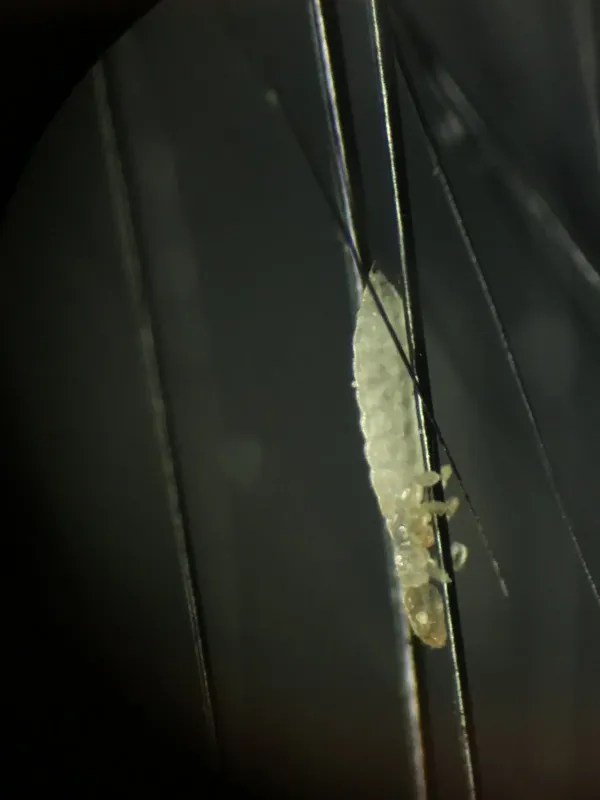
The guinea pig louse (Gliricola porcelli) is a small insect belonging to the order Phthiraptera, family Gyropidae. These parasites have a flattened, yellowish-white body, approximately 1–1.5 mm long, which allows them to move quickly through the host's dense coat.
This species is a highly specialized parasite that affects only guinea pigs. Their entire life cycle is spent on the host's body, where they feed on epidermal scales, skin secretions, and hair debris, staying close to the skin surface.
The life cycle consists of the egg (nit), three nymphal stages, and the adult phase. Under favorable conditions, the entire development from egg to reproductive adult takes about 2–3 weeks, which allows the population to grow rapidly if left untreated.
Females secure their eggs to the hair shaft near the base using a specialized secretion. This bond is very strong, making it nearly impossible for the animal to remove the eggs through natural scratching or grooming behaviors.
The parasite is highly dependent on the host environment. Off the animal, the louse is vulnerable and typically dies within a few days due to the lack of food and the absence of the specific body temperature required for its survival.
What it damages
It is important to clarify that this organism is not a plant pest. It is exclusively an animal ectoparasite and causes no damage to crops, garden plants, or agricultural products.
The main harm caused by these lice is the irritation of the skin, leading to severe pruritus (itching). The guinea pig becomes restless, scratches incessantly, and may bite at its own skin, resulting in self-inflicted wounds and hair loss.
Constant scratching compromises the skin barrier, creating entry points for secondary bacterial infections. This can lead to painful dermatitis, crusting, and inflamed skin patches that require clinical intervention.
In young or weak guinea pigs, a heavy infestation can cause significant weight loss, failure to thrive, and overall lethargy. The constant stress of the infestation weakens the animal's immune system, making it susceptible to other health issues.
Severe infestations can also cause matting of the coat, which is detrimental to the animal's hygiene and comfort. In show guinea pigs, the parasite causes significant aesthetic damage to the quality of the coat.
Signs of infestation
The primary sign of an infestation is the presence of small, white, fast-moving insects visible when parting the hair. They are most commonly found in the rump area, behind the ears, and along the neck.
Nits appear as tiny, light-colored capsules firmly attached to the base of the hair. Unlike dandruff, these capsules do not brush off easily and maintain a consistent, elongated shape upon closer inspection with a magnifying glass.
Behavioral changes are significant: the pet will spend excessive time scratching or biting at its fur. Patches of thinning hair or crusty skin are often the result of the parasite's activity, which owners may initially mistake for fungal or mite infections.
The coat may appear dull or unkempt, with localized areas of matting. In severe cases, the skin may show redness and inflammation, and the animal might become uncharacteristically grumpy or aggressive due to the persistent discomfort.
Professional diagnosis involves physical examination and skin scrapings viewed under a microscope. Vets look for the distinct morphology of Gliricola porcelli to confirm the infestation before recommending treatment.
Control measures
Control is achieved primarily through the application of veterinary-approved antiparasitic treatments, such as topical spot-ons, sprays, or powders formulated for small rodents. Never use products meant for dogs or cats without explicit veterinary guidance.
Environmental management is crucial. The entire cage, including food bowls, water bottles, and bedding, must be thoroughly cleaned and disinfected. All organic bedding should be discarded and replaced to eliminate any surviving eggs or nymphs.
If there are multiple guinea pigs in the enclosure, all animals must be treated simultaneously, even if only one shows visible signs. This prevents the parasite from simply migrating back and forth between hosts.
Follow-up treatments are often necessary. Because most insecticides kill adult lice but may not penetrate the eggs, a second application after 7–14 days is vital to eliminate the newly hatched generation and break the life cycle.
- Quarantine new guinea pigs before introducing them to the group.
- Maintain high cage hygiene by replacing bedding regularly.
- Use only safe, vet-prescribed antiparasitic medications.
- Monitor the animals' skin and coat regularly during routine grooming.
Taxonomy
- Latin name
- Gliricola porcelli
- Family
- Gyropidae
- EPPO code
- GLIRPO
Discussion
No discussions yet — be the first.