
Gerstaeckeria fasciata
Gerstaeckeria fasciata
Description
How to identify
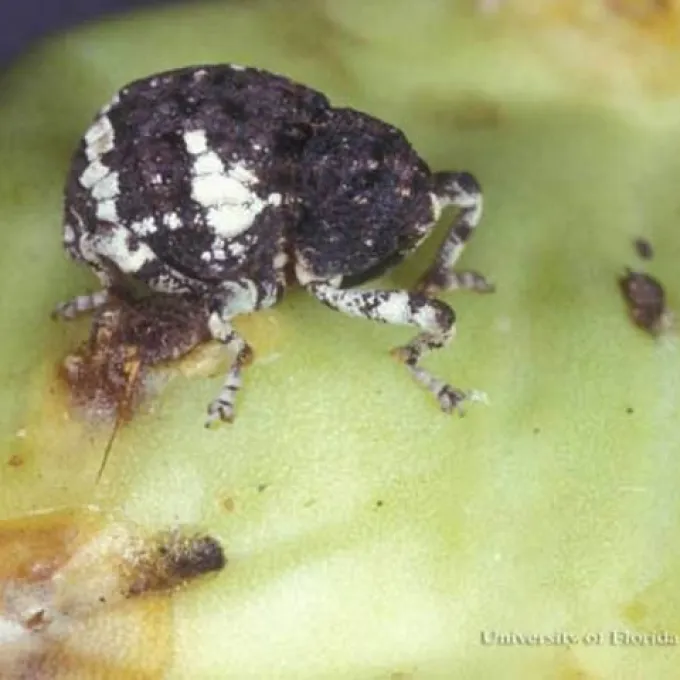
Gerstaeckeria fasciata is a species of weevil belonging to the Curculionidae family. Adult beetles typically measure between 5 to 8 millimeters in length.
The insect's body has an oval shape and is covered with dense, dark-brown to black scales, which create distinct transverse bands across the elytra.
This beetle is well-adapted to xeric environments, featuring a robust exoskeleton that prevents desiccation during hot weather.
The larvae are typical of the weevil group: legless, creamy-white in color, with a sclerotized dark head capsule suited for boring into plant tissue.
Identification is best achieved by examining the characteristic snout of the adult beetle and observing its specific feeding patterns on the host plant.
What it damages
The primary hosts for Gerstaeckeria fasciata are cacti, particularly species within the Opuntia genus, which are often targets for this pest.
Both adults and larvae consume the inner parenchyma tissues of the cactus pads and fruits, creating extensive internal galleries.
This feeding activity weakens the plant structure, causing physiological stress, reduced growth rates, and a significant loss in the plant's aesthetic and commercial value.
Severe infestations often lead to secondary rot infections caused by opportunistic bacteria and fungi that enter the plant through the holes bored by the weevils.
In commercial cactus cultivation, this pest can cause substantial economic losses by ruining fruits and damaging entire segments of the crop.
When it appears
The life cycle of Gerstaeckeria fasciata is strongly linked to the seasonal growth cycles of its host cacti and local temperature fluctuations.
Adult beetles become active in early spring when temperatures are conducive to emergence from their overwintering sites.
Reproduction occurs throughout the warm months, and under favorable conditions, multiple generations can occur within a single year.
Overwintering is typically performed by adults, which seek shelter within the dead or hollowed tissues of the host plant or in the debris surrounding the base.
Population spikes often correlate with the peak vegetative growth phase of the host plants, providing abundant food resources for the larvae.
Signs of infestation
Early symptoms of infestation include small, circular entry holes on the surface of the cactus pads or fruits.
Affected areas may feel soft or hollow when palpated, indicating that the internal tissue has been consumed by the developing larvae.
Frass (larval excrement) is often visible on the exterior of the cactus, appearing as fine, brownish dust pushed out from the internal galleries.
Yellowing, localized tissue necrosis, and eventual shriveling of the cactus segments are common signs of advanced infestation.
Opening a damaged pad will typically reveal tunnels filled with frass, along with the presence of larvae or pupae in various stages of development.
Control measures
Effective management of this pest involves a combination of mechanical removal and chemical intervention strategies.
Systemic insecticides are the most effective chemical control, as they are absorbed by the plant and target the larvae hidden inside the fleshy tissues.
Sanitation practices, such as removing and destroying infested plant pads, are crucial to reducing the local population and preventing further spread.
Regular monitoring of cactus collections using visual inspection or pheromone traps helps in detecting the arrival of the weevil before damage becomes severe.
- Application of systemic pesticides during the egg-laying period.
- Mechanical removal of infected plant segments.
- Quarantine protocols for new plant material.
Taxonomy
- Latin name
- Gerstaeckeria fasciata
- Order
- Coleoptera (beetles)
- Family
- Curculionidae
- EPPO code
- GERTFA
Discussion
No discussions yet — be the first.