
Birch leaf miner
Fenusa pumila
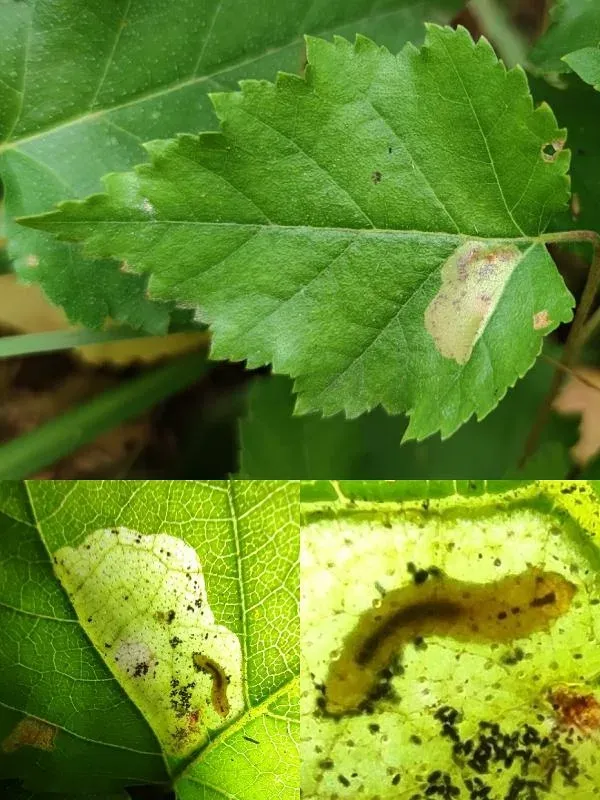
Description
How to identify
The birch leaf miner Fenusa pumila belongs to the order Hymenoptera, family Tenthredinidae. The adult is a small insect, about 3–4 mm long, with a shiny black body.
The larva has a flattened, cream-colored body with a brown head. The larval stage is the most damaging to the plant, as it leads a hidden life inside the leaf tissue.
The development cycle includes complete metamorphosis: egg, larva, pupa, and adult. In temperate climates, this pest can complete two or sometimes three generations per season, increasing its overall impact.
The insect overwinters as a pupa in a cocoon buried in the soil under the tree canopy. As soon as the weather warms up, adults emerge, mate, and begin laying eggs.
Females lay eggs individually into slits on the surface of young birch leaves. A single female can damage a significant number of leaves, laying up to 50 eggs during her life.
What it damages
The primary hosts are various species of birch, including silver birch and downy birch. In rare cases, the pest can infest alder if it grows in close proximity to birch plantations.
Damage occurs when larvae consume the internal leaf tissue, creating mines. Adults cause only minor damage during egg-laying, which has little impact on the plant's decorative value.
Significant damage is inflicted on young trees in nurseries and forest parks. Massive leaf infestation leads to a reduction in the tree's photosynthetic capacity, weakening its immune system and making it vulnerable to secondary pests.
Trees subjected to severe infestation may shed their leaves prematurely. This slows down the annual shoot growth and negatively affects the overall cold hardiness of the trees.
In urban landscapes or parks, the pest ruins the aesthetic appeal of tree lines. Decorative birches lose their attractiveness due to extensive areas of dry, brown leaf tissue.
When it appears
The first signs of adult activity are observed in late May when air temperatures reach optimal levels. The emergence is spread over time, which complicates early-stage pest control.
Larvae feed actively throughout June and July. During this period, characteristic damage appears quickly on leaves and becomes visible to the naked eye upon inspection of the canopy.
The second generation peaks in August. It is during this time that the most intense mine formation occurs, potentially covering up to 50-70% of the leaf surface area.
Development of one generation from egg to exiting the mine takes about 3–4 weeks. Dry and warm weather in early summer provides favorable conditions for rapid reproduction.
In late September, larvae leave the mines and descend into the soil to a depth of 5–10 cm to pupate and overwinter. Visual evidence of damage persists on fallen, dried leaves.
Signs of infestation
The main sign of infestation is irregularly shaped mines on the leaves. Initially, they appear as light, translucent patches that eventually turn brown and dry out.
Upon closer inspection against the light, one can see the larva or its excrement in the form of small black granules inside the mine. This is a key distinction between leaf miner damage and fungal diseases.
Damaged leaves often show signs of wrinkling and premature tissue necrosis. Gradually, these leaves fall off, even in the middle of summer.
During massive outbreaks, the birch canopy looks "scorched." In strong winds, the damaged leaf tissue may tear, creating a ragged edge effect on the healthy part of the leaf.
The presence of small exit holes in the soil under the tree, left by larvae when moving to pupate, is also an indirect sign of a high population density from the previous season.
Control measures
Effective protection includes agrotechnical methods. It is important to cultivate the soil under the tree canopy in autumn or early spring to destroy cocoons containing overwintering pupae.
Collecting and burning fallen leaves, where late-generation larvae may reside, is mandatory. This significantly reduces the pest pressure for the following year.
When infestation levels are high, systemic chemical insecticides are applied. Preparations based on imidacloprid or abamectin effectively penetrate the leaf tissue, targeting the larvae inside the mines.
Biological control methods include attracting insectivorous birds to the site and utilizing natural enemies (entomophages). However, in urban settings, chemical treatment remains the most reliable method.
- Perform insecticide applications during the peak adult flight period.
- Use systemic products to eliminate larvae residing inside the leaves.
- Maintain tree vigor through regular watering and fertilization.
Taxonomy
- Latin name
- Fenusa pumila
- Order
- Hymenoptera
- Family
- Tenthredinidae
- EPPO code
- FENUPM
Discussion
No discussions yet — be the first.