
Polyphagous shot hole borer
Euwallacea fornicatus
Description
How to identify
The polyphagous shot hole borer (Euwallacea fornicatus) is a small beetle belonging to the Curculionidae family, subfamily Scolytinae. Adult females are cylindrical, dark brown to black, and measure approximately 2 mm in length.
Males are significantly smaller, flightless, and remain inside the galleries. Due to their small size and cryptic nature, they are rarely seen outside of their tunnels, making early detection difficult.
The life cycle involves the female boring into the wood to create galleries, where she introduces symbiotic fungi. Larvae develop within these tunnels, feeding exclusively on the fungal mycelium.
This beetle is a vector for Fusarium species. The symbiotic relationship between the beetle and the fungus is the primary cause of plant death, as the fungus disrupts the host's vascular system.
It is part of a species complex often referred to as the PSHB, which has become a significant invasive threat to both urban forests and commercial agricultural plantations globally.
What it damages
Euwallacea fornicatus is an extreme polyphage, capable of infesting hundreds of different plant species, including both native trees and major agricultural crops.
Major crops affected include avocado, macadamia, tea, and citrus. In urban and natural environments, it poses a severe threat to hardwoods such as maples, oaks, and sycamores.
Unlike many other bark beetles that target already stressed trees, this species is aggressive and can attack healthy, vigorous trees, leading to rapid decline.
The damage is two-fold: the mechanical boring weakens the wood structure, while the fungal infection creates lesions that block the transport of water and nutrients.
In highly susceptible hosts, heavy infestation leads to branch dieback, crown thinning, and eventually the total mortality of the tree within a few growing seasons.
Signs of infestation
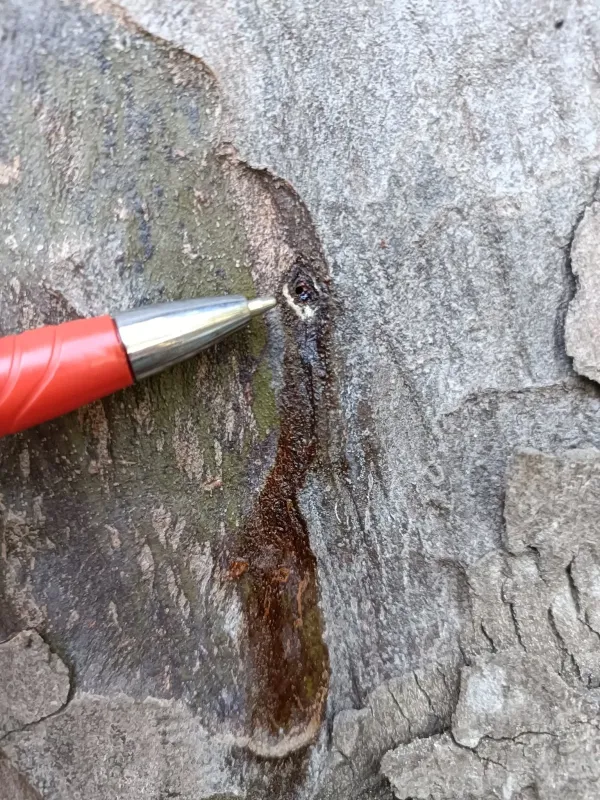
The most characteristic sign of an infestation is the presence of small, perfectly round entry holes, approximately 1–2 mm in diameter, on the surface of the bark.
In some species, such as avocado, white powdery or crusty exudates (often called 'sugar volcanoes') may form around the entrance holes due to the tree's immune response.
Dark, wet stains on the bark are common symptoms indicating that the fungal infection has begun to spread into the surrounding xylem tissue.
Fine wood dust, often resembling sawdust or flour, accumulates near the base of the tree or on branches, signifying active boring activities within the wood.
External symptoms often include wilting of leaves, yellowing of the canopy, and the dieback of branches, which may progress rapidly as the infestation density increases.
Control measures
Managing this pest is exceptionally challenging because the beetles spend most of their life cycle protected deep within the woody tissues where insecticides cannot reach.
The primary control strategy is strict sanitation: infested branches or entire trees must be removed, chipped to a small size, or burned on-site to destroy the population.
Quarantine measures are critical to prevent the spread of the pest via the movement of firewood, nursery stock, and green waste from infested regions to clean areas.
Monitoring programs using specialized lures and sticky traps are essential for early detection, especially in high-value orchard environments and botanical gardens.
Research into biological control agents and systemic fungicide treatments is ongoing, but currently, integrated pest management focused on early detection and host removal remains the best approach.
Taxonomy
- Latin name
- Euwallacea fornicatus
- Order
- Coleoptera (beetles)
- Family
- Curculionidae
- EPPO code
- XYLBFO
Discussion
No discussions yet — be the first.