

European grapevine moth
Eupoecilia ambiguella
Description
How to identify
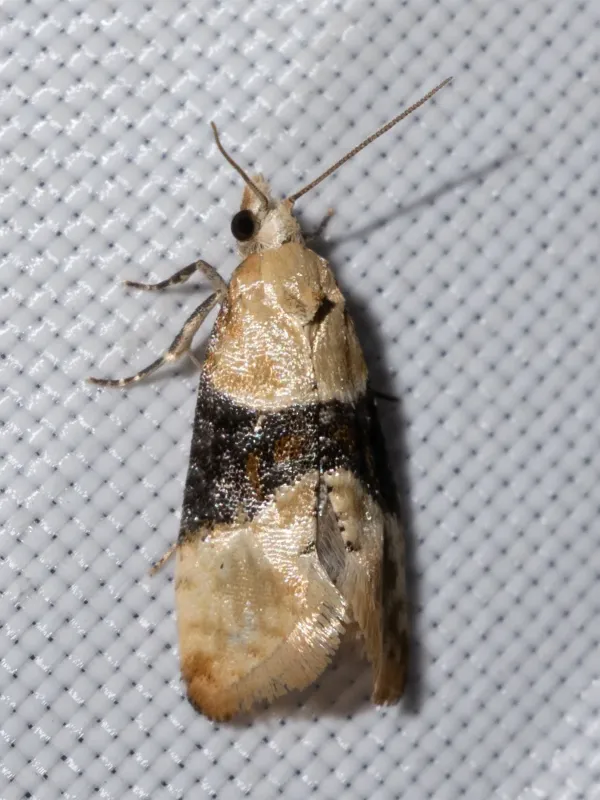
The European grapevine moth (Eupoecilia ambiguella) is a significant lepidopteran pest belonging to the Tortricidae family. The adult moth has a wingspan of 12–15 mm and is recognizable by its yellowish-ochre forewings with a prominent dark central band.
The larvae progress through several instars, changing from a light cream color to a dull greenish or brownish hue as they mature. Fully grown larvae reach approximately 10–12 mm in length and are highly active.
Pupation occurs within dense silken cocoons. These are typically hidden in crevices of the grapevine bark, trellis posts, or under debris on the vineyard floor, providing protection during the winter season.
Adult emergence in the spring is triggered by rising temperatures, usually when the daily average exceeds 10–12°C. This activity often coincides with the budburst and flowering stages of the vine.
Depending on the climatic conditions of the region, this species completes two to three generations annually. Each cycle presents a recurring threat to the development of the grape clusters.
What it damages
The larvae are primarily destructive to the reproductive organs of the vine. They feed on floral buds, developing ovaries, and ripening berries, causing significant economic damage throughout the growing season.
First-generation larvae web floral clusters together, consuming the buds. This behavior leads to cluster shedding, which can severely reduce the total potential crop yield from the very beginning of the season.
Second and third-generation larvae penetrate the grape berries. By feeding on the internal pulp and seeds, they destroy the fruit and create pathways for secondary infections like botrytis or grey rot.
Damaged berries often show signs of necrosis, rotting, and mold growth. This degradation makes the grapes unsuitable for winemaking or fresh market consumption, significantly lowering overall quality.
In cases of high infestation, the pest can cause a reduction in yield exceeding 50%. The cumulative effect of larval feeding disrupts sugar accumulation and overall maturation of the grape bunches.
Signs of infestation
The presence of silken webbing on the floral clusters is the most reliable early-season indicator of a grapevine moth infestation. These webs often contain small, chewed bud remnants.
During the summer months, shriveled or deformed berries are clear signs of larval activity. Inspection of these berries typically reveals small entry holes surrounded by larval excrement.
A foul odor or the presence of moldy growth on bunches is often a late-stage indicator that the larvae have compromised the integrity of the fruit, leading to secondary fungal decay.
In the evening, the presence of adult moths flying around the vine canopy indicates an active population. Monitoring this activity is essential for timely intervention.
Pheromone traps are essential tools for vineyard managers to track population spikes. A sudden increase in trapped moths serves as a prompt for scheduled control applications.
Control measures
Cultural control practices, such as removing old bark from trunks and clearing vineyard debris, reduce overwintering sites for the pupae. Maintaining clean vineyard rows is a fundamental preventive measure.
Biological control, including the application of Bacillus thuringiensis, is highly effective against young larvae. This method is environmentally friendly and helps maintain the presence of natural beneficial insects.
Chemical control must be timed precisely with the emergence of the larvae. Applications are most successful when targeted at newly hatched larvae before they enter the interior of the grape berries.
Mating disruption using pheromone dispensers is a sophisticated technique that prevents male moths from locating females, thereby significantly reducing the reproductive potential of the next generation.
- Mechanical cleaning of grapevine bark
- Pheromone trap monitoring
- Application of microbial insecticides
- Targeted chemical spray programs
- Biological control using parasitic wasps
Content graph
Connections · European grapevine moth
Most often together:
Marketplace
Products · 1
Biology
Taxonomy
- Latin name
- Eupoecilia ambiguella
- Order
- Lepidoptera (butterflies)
- Family
- Tortricidae
- EPPO code
- CLYSAM
Community
Discussion
No discussions yet — be the first.