
Ethmia bipunctella
Ethmia bipunctella
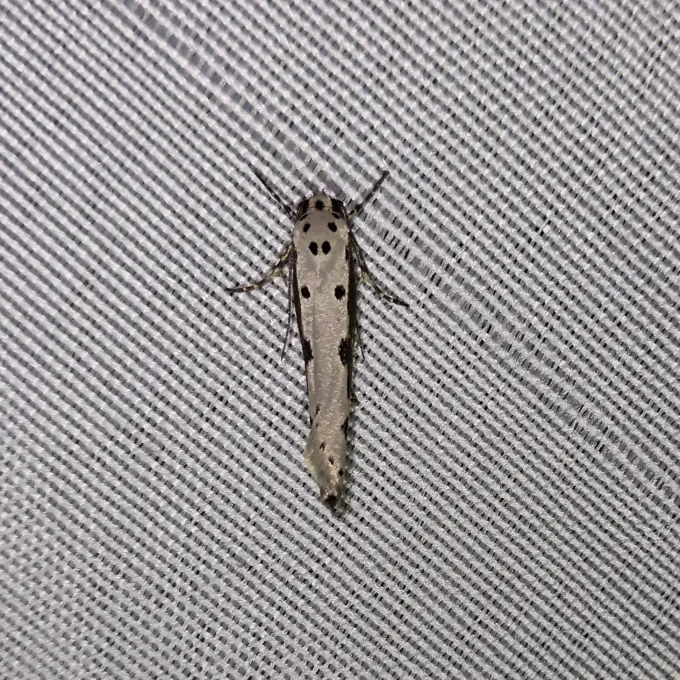
Description
How to identify
Ethmia bipunctella is a species of moth belonging to the family Ethmiidae within the order Lepidoptera, often recognized by its distinct appearance.
The adult moth features silver-white or light-grey forewings adorned with a series of symmetrical black dots and spots, giving it a characteristic spotted look.
The larvae, or caterpillars, reach lengths of up to 20 mm and are known for their dark, patterned bodies that feature contrasting light markings for warning coloration.
Pupation occurs within a tough, resilient cocoon, which the caterpillar constructs in the soil or amidst plant debris to survive environmental stressors.
The wingspan typically measures between 20 and 25 mm, and the moths are primarily active during the night, hiding in foliage during the bright daylight hours.
What it damages
The primary larval food plants for Ethmia bipunctella are species of the genus Echium, commonly known as viper's bugloss, which are often classified as weeds.
Damage is caused by the caterpillars feeding on the leaves, which reduces the plant's photosynthetic capacity and weakens the overall vegetative structure.
Under conditions of high population density, the larvae may defoliate entire plants, leaving behind only the veins and leading to significant tissue loss.
Attacking the flower buds can drastically reduce the seed production of the host plant, impacting its ability to reproduce and spread within the field.
Though they primarily target weeds, if these weeds are in close proximity to commercial crops, the infestation can accidentally extend to neighboring beneficial vegetation.
When it appears
Adult moths are typically observed during the summer months, specifically from June through August, which constitutes their main mating and egg-laying period.
The life cycle often consists of one or two generations annually, with development speed heavily dictated by regional temperatures and local climate conditions.
The species overwinters in the pupal stage, buried safely within the soil, where it remains dormant until warmer spring temperatures trigger the emergence of adults.
Emergence in the spring is synchronized with the availability of fresh host plant foliage, ensuring immediate food sources for the newly hatched larvae.
Humidity plays a critical role in the timing of the life cycle, with moist conditions generally favoring higher survival rates for the emerging pupae.
Signs of infestation
The most immediate sign of infestation is the appearance of irregular holes in the leaves of Echium species, caused by the feeding activity of the larvae.
Silk webbing is frequently observed on the tips of host plants, as caterpillars bind leaves together to create a sheltered microhabitat for protection.
Dark fecal pellets, or frass, left behind on the surface of the leaves are clear indicators of active feeding by the caterpillars during the growth phase.
Visible thinning of the foliage and premature wilting of terminal shoots are indicators that the larvae have caused significant structural damage.
- Irregular leaf holes and ragged margins.
- Silk webbing present on shoots and leaf clusters.
- Dark granular frass on the leaves.
- Presence of spotted adult moths near host plants.
Control measures
Effective management begins with mechanical control, such as the removal and destruction of host weed species to eliminate the primary breeding ground.
Deep autumn tilling of the soil is highly recommended to expose the overwintering pupae, making them vulnerable to cold temperatures and natural predators.
Biological control using Bacillus thuringiensis sprays has proven successful in reducing larval populations without causing harm to beneficial insect species.
Chemical intervention should be restricted to cases of severe outbreaks where economic damage thresholds are exceeded, emphasizing the need for targeted application.
Regular monitoring through the use of light traps helps track the moth population density, allowing for timely decision-making in integrated pest management programs.
Taxonomy
- Latin name
- Ethmia bipunctella
- Order
- Lepidoptera (butterflies)
- Family
- Ethmiidae
- EPPO code
- ETHMBI
Discussion
No discussions yet — be the first.