
Walnut sawfly
Eriocampa juglandis
Description
How to identify
The walnut sawfly (Eriocampa juglandis) is a member of the Tenthredinidae family within the order Hymenoptera. Despite the name, they are not flies but relatives of bees and wasps, although their larvae are frequently confused with lepidopteran caterpillars.
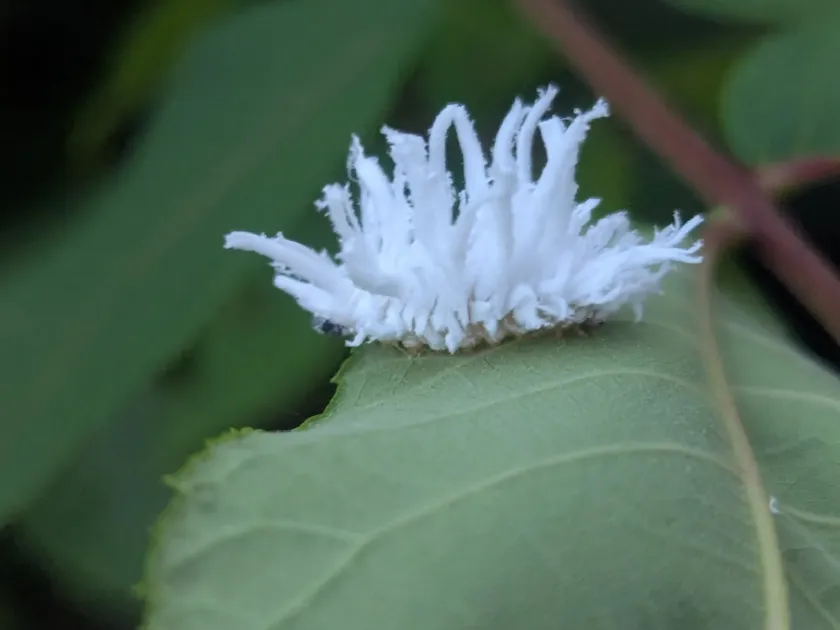
Adults are small, dark-colored insects with transparent wings. The larvae typically exhibit a distinct appearance, often covered in a wax-like secretion that acts as a physical barrier against environmental stressors and potential predators.
Their life cycle is synchronized with the phenology of walnut trees. Adult emergence from soil-bound cocoons occurs in early spring, precisely when leaf buds begin to unfold, providing immediate nutrition for the emerging larvae.
Reproduction varies from univoltine to multivoltine depending on the geographical region and local climate. After mating, females lay eggs inside the leaf tissue, ensuring that larvae have protected access to food upon hatching.
Pupation takes place underground. This subterranean stage is crucial for their survival, allowing the species to endure harsh winter conditions by remaining in durable cocoons deep within the soil profile.
What it damages
The primary hosts for this pest are species of the genus Juglans, specifically the common walnut. The damage is exclusively caused by the feeding larvae, which target the foliage of the tree throughout the growing season.
Larvae feed by skeletonizing the leaves. They consume the soft mesophyll tissue, leaving only the vascular network intact, which severely impairs the leaf's photosynthetic capacity and efficiency.
Extensive skeletonization leads to early senescence and premature leaf drop. This foliage loss significantly weakens the tree, reducing its ability to synthesize energy and store resources for winter dormancy.
Reduced photosynthetic activity impacts fruit development, often resulting in smaller nut sizes and lower oil content in the kernel, which significantly diminishes the overall harvest quality.
Repeated annual infestations can lead to branch dieback and overall tree decline, making the host plant more susceptible to secondary pathogens and climate-induced stressors that can prove fatal.
Signs of infestation
Early warning signs of an infestation include the appearance of tiny, irregular holes in the leaf surface, which correspond to the feeding activity of young larvae in their initial instars.
A tell-tale sign is the presence of lace-like, skeletonized leaves. When observed against sunlight, the damaged foliage appears as a skeletonized network of veins, indicating a mature larval population.
Colonies of larvae are often found clustered on the underside of leaves. Their gregarious feeding behavior makes them relatively easy to spot if a systematic inspection of the lower canopy is performed.
The accumulation of dark, pellet-like frass (excrement) on the leaves or on the ground beneath the tree canopy is a clear indicator of a significant infestation that requires immediate attention.
Severe infestations result in a visible browning of the crown. The leaves eventually curl, become brittle, and drop off, leading to a thinning of the canopy that is apparent even from a distance.
Control measures
Effective management begins with mechanical control. Cultivating the soil in the orchard during late autumn or early spring can expose and destroy the overwintering cocoons, significantly reducing the population for the following year.
Manual removal of infested leaves or clusters of larvae can be highly effective in small-scale gardens or on young trees, preventing the spread of the infestation to the entire canopy.
Chemical control involving systemic or contact insecticides should be timed to coincide with the larval hatch phase. Targeting early-stage larvae is crucial to minimize foliage damage and prevent potential harvest loss.
Biological control agents, including specialized pathogens or naturally occurring predators such as predatory bugs and parasitic wasps, play a vital role in maintaining ecological balance in larger orchards.
- Maintain vigorous tree health through proper fertilization and irrigation.
- Monitor for adult activity using pheromone or sticky traps.
- Promote biodiversity to support beneficial insect populations.
- Prune out heavily infested branches to reduce local pest density.
Taxonomy
- Latin name
- Eriocampa juglandis
- Order
- Hymenoptera
- Family
- Tenthredinidae
- EPPO code
- ERIAJU
Discussion
No discussions yet — be the first.