
Common Mayfly
Ephemera vulgata
Description
How to identify
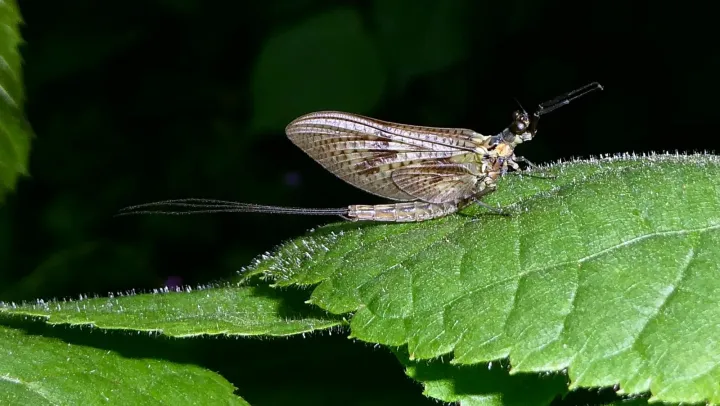
The common mayfly (Ephemera vulgata) belongs to the order Ephemeroptera and the family Ephemeridae. It is characterized by a delicate body, transparent wings with a distinct vein network, and long caudal filaments.
Adults are short-lived and do not feed, as their mouthparts are vestigial. Their primary function is reproduction within a very brief window of time, often just a single day.
The nymphs are aquatic organisms that live in the silt of freshwater bodies. They possess robust jaws and gills along their abdomen to facilitate underwater respiration.
Development from nymph to adult involves multiple molts and can span one to three years, representing the longest phase of their life cycle.
During the mating season, mayflies perform distinct rhythmic swarming behaviors above the water surface, which is a classic biological phenomenon.
What it damages
Ephemera vulgata is not an agricultural pest and does not cause damage to field crops, orchards, or vegetable gardens.
They do not consume plant tissues, roots, or fruits, making them completely harmless to any form of commercial agricultural production.
Mayflies are considered beneficial to the environment because their larvae contribute to the decomposition of organic matter in aquatic systems.
They serve as a vital food source for various fish and bird species, supporting the biodiversity of ecosystems adjacent to farmland.
Agricultural practices remain unaffected by the presence or lifecycle of these insects, as they are strictly tied to aquatic environments.
When it appears
The main emergence of adult mayflies typically occurs in late spring or early summer, primarily during May and June.
Timing is heavily influenced by water temperature and environmental conditions, which trigger the transition from the nymph stage.
Evening hours are the most common time for swarming behavior, as adults take flight to reproduce before their short lifespan concludes.
The larval stage is a continuous process occurring throughout the year within the substrate of rivers and ponds.
Variations in emergence timing are often used by ecologists as indicators of seasonal changes in local water bodies.
Control measures
There are no control measures for the common mayfly because it does not pose a threat to agricultural productivity.
The use of insecticides is strongly discouraged as it would unnecessarily harm aquatic life and disrupt the local ecological balance.
Farmers should view the presence of these insects as a positive indicator of water quality near their irrigation sources.
No intervention or management strategy is required for this species within an agronomic framework.
Allowing natural processes to regulate the mayfly population is the most sustainable and recommended approach for land management.
Taxonomy
- Latin name
- Ephemera vulgata
- Family
- Ephemeridae
- EPPO code
- EPHMVU
Discussion
No discussions yet — be the first.