
Mayfly
Ephemera
Description
How to identify
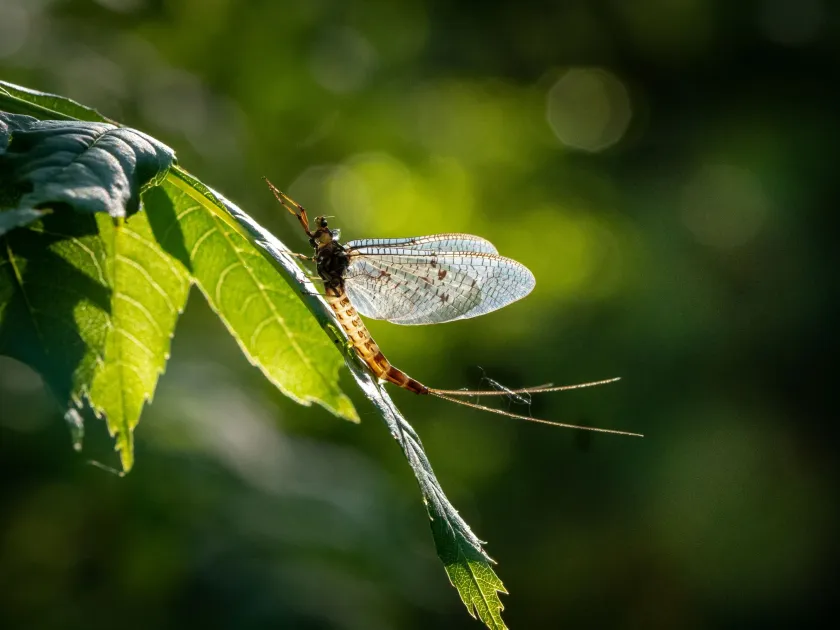
Mayflies (order Ephemeroptera, family Ephemeridae) are ancient winged insects recognized by their delicate appearance and very short adult life cycle. Adults possess slender bodies and distinct, long tail filaments.
Their wings are transparent with a dense network of veins, typically held upright when at rest. This characteristic silhouette is a key identifier when observing them in nature near freshwater habitats.
The immature stage, known as a nymph or naiad, is strictly aquatic. They are equipped with tracheal gills along the abdomen, allowing them to respire dissolved oxygen efficiently in various water conditions.
Adult mayflies lack functional mouthparts, meaning they cannot consume food. Their sole purpose in the adult phase is to mate and lay eggs, after which they die within a few hours or days.
A unique evolutionary feature of this group is the subimago stage, a pre-adult phase where the insect is capable of flight but must undergo a final molt to reach sexual maturity.
What it damages
Mayflies are not agricultural pests. They do not feed on crops, vegetables, or fruits, as their mouthparts are vestigial and non-functional. They pose no threat to the commercial value of agricultural produce.
Similarly, the nymphs do not damage plants. They live in sediments at the bottom of ponds or rivers, feeding on organic detritus and algae, which helps in the natural cleaning of water bodies near farms.
Because they do not damage crops, they should not be targeted by insecticides. Farmers often mistake their mass appearance for an infestation, but they are entirely benign visitors to the farm environment.
Their presence is actually a positive environmental indicator. Since mayfly larvae are highly sensitive to pollution, their abundance confirms that nearby water sources are free from heavy pesticides.
In conclusion, mayflies contribute to a healthy ecosystem by serving as a food source for fish and birds, playing an essential role in the local food chain rather than harming agricultural efforts.
When it appears
The emergence of adult mayflies typically occurs from late spring through summer. This event often happens in synchronized swarms that can last from a few days to several weeks.
The timing is highly dependent on water temperature and regional climate. Warmer temperatures can accelerate the development of nymphs, causing adult swarms to appear earlier in the season than usual.
Nymphs spend a significant amount of time in the water, ranging from one to three years depending on the species. During this time, they remain hidden from view, feeding and growing in the substrate.
Mass emergences are often synchronized with dusk, when the adults take flight to reproduce. This phenomenon is a natural ecological event that is highly beneficial to the local biodiversity.
Agricultural managers should be aware of these natural cycles to distinguish them from actual pest outbreaks, ensuring that unnecessary and harmful pest control measures are avoided.
Control measures
No pest control measures are needed for mayflies. As they do not harm crops and are vital components of the ecosystem, any attempt to eradicate them is counterproductive and environmentally damaging.
If large numbers gather around farm buildings due to artificial light, simply switching off lights or using motion sensors can minimize their presence. They are attracted to light, but the phenomenon is always temporary.
Maintaining the quality of water bodies near the farm is the best way to support these insects. A healthy aquatic environment fosters biodiversity and keeps the farm's surrounding ecosystem balanced.
Farmers should focus on targeted pest management for actual threats while preserving the habitats of beneficial species like mayflies to keep the natural environment thriving.
Education is key. Ensuring that farm staff understands the ecological role of mayflies prevents unnecessary worry during the short period when these fascinating insects are active.
Taxonomy
- Latin name
- Ephemera
- Family
- Ephemeridae
- EPPO code
- EPHMSP
Discussion
No discussions yet — be the first.