
Mayfly
Ephemera danica
Description
How to identify
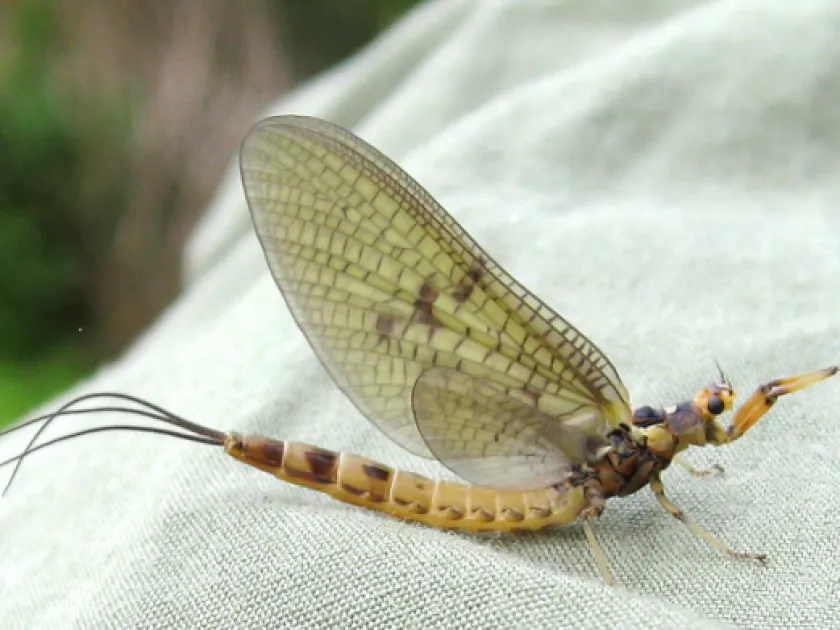
The mayfly (Ephemera danica) belongs to the order Ephemeroptera, family Ephemeridae. Adult insects are characterized by their fragile bodies, measuring up to 25 mm, and three distinct long tails called cerci.
Their wings are transparent with a dense network of veins. The adult stage is unique because it lacks functional mouthparts and a digestive system, as they do not feed during their short adult life.
Nymphs live in the substrate of running water bodies. They have well-developed mandibles for feeding on detritus and organic matter found in the river bed sediment.
A key identifying feature is the presence of gills along the sides of the abdomen, which are vital for respiration in aquatic environments.
The transition from nymph to adult involves a unique stage called the subimago, which is the only instance in the insect world where a winged stage molts into another winged stage.
When it appears
The emergence of adults typically occurs from May through July. This seasonal phenomenon involves mass swarming events above the surface of clean streams and rivers.
The nymphal stage is remarkably long, lasting between one to two years depending on water temperatures and the availability of nutrients in the riverbed.
These insects are highly sensitive to environmental stressors. Their emergence is strictly regulated by the water quality and temperature, making them excellent bioindicators.
Activity peaks during the twilight hours when swarming and mating flights are most frequent, ensuring the reproductive success of the species.
The adult lifespan is ephemeral, often lasting only a few hours or up to a few days, after which the individuals die, providing nutrients back into the ecosystem.
Taxonomy
- Latin name
- Ephemera danica
- Family
- Ephemeridae
- EPPO code
- EPHMDA
Discussion
No discussions yet — be the first.