
American red-striped leaf beetle
Entomoscelis americana
Description
How to identify
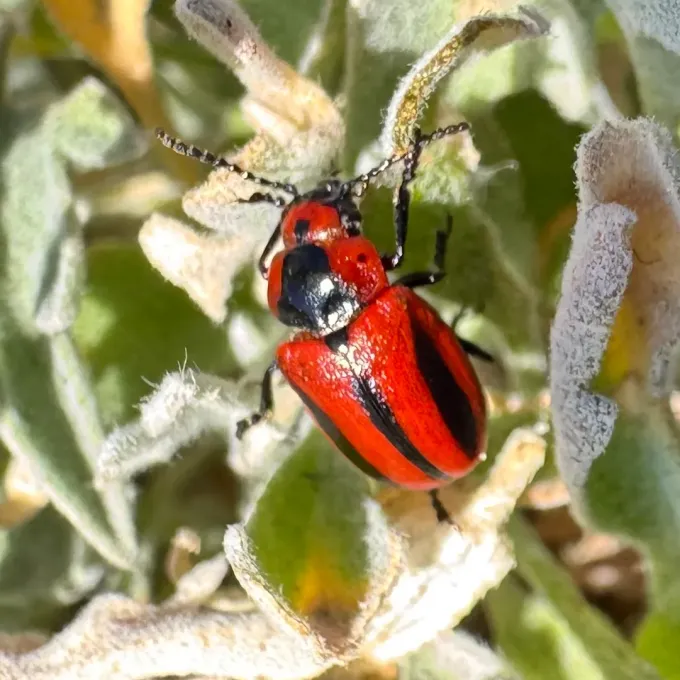
The American red-striped leaf beetle (Entomoscelis americana) belongs to the order Coleoptera and the family Chrysomelidae. This beetle is approximately 6–7 mm long and has a distinctive bright appearance: red-orange elytra with three longitudinal black stripes.
The body of the insect is oval-shaped, with a shiny black head and pronotum. The larvae go through several developmental stages; they have an elongated, slightly curved body with a dark gray or brownish hue and visible spots.
Particular attention should be paid to identifying adult beetles when they emerge after overwintering. Unlike many other leaf beetles, this species is most active in regions with cool or temperate climates, where it occupies a specific ecological niche.
The developmental phases include the egg, larva, pupa, and adult. The insect's eggs are oval and are deposited primarily on the soil or plant debris near host plants.
It is important not to confuse this species with other flea beetles, as management strategies may differ due to the life cycle characteristics of the American red-striped leaf beetle, which overwinters in the egg stage.
What it damages
The primary food source for this pest is the family Brassicaceae. Host plants include canola, mustard, radish, turnip, and various types of cultivated or wild cabbage.
Both larvae and adult beetles pose a threat to crops at different stages of vegetation. The damage manifests as intense consumption of leaf tissue, leading to a decrease in the plant's photosynthetic activity.
In cases of massive outbreaks, the pest can completely destroy young seedlings within a few days. This creates a critical threat to fields planted with canola, especially in the cotyledon and early true leaf stages.
Adults can also damage generative organs, including buds and flowers, which directly affects seed yield formation and reduces the oil content of the crop.
Beyond direct defoliation, the wounds caused by feeding become entry points for secondary bacterial and fungal infections, further weakening the immunity of agricultural crops.
When it appears
The life cycle of the American red-striped leaf beetle is strictly tied to seasonal temperature regimes. The pest overwinters exclusively in the egg stage, located in the upper layer of the soil.
In the spring, as soon as the soil warms up to the necessary temperatures, the larvae hatch. This process typically coincides with the beginning of the germination of weeds and the emergence of cultivated plants.
The larval feeding period lasts for several weeks, followed by a pupation stage in the soil. The emergence of the new generation of young beetles usually occurs in mid-to-late summer.
Adult beetles are active during the hot periods of summer; however, their life cycle is often limited, as they die after mating and egg-laying.
Thus, the main peak of damage occurs in the early spring, when plants are most vulnerable, and in late summer as the population prepares for the next season.
Signs of infestation
The first sign of the pest's presence is the appearance of through-holes or uneven edges on leaves. Larvae often feed in groups, skeletonizing the leaf blade down to the veins.
Adult beetles leave behind larger, jagged damage patterns. During field inspections, insects can be seen on the underside or upper surface of leaves during the early morning and evening hours.
The presence of large amounts of excrement on leaf surfaces is an indirect sign of high pest population density.
In cases of heavy infestation, general stunting of plant growth, yellowing, and premature wilting of the affected areas can be observed.
For monitoring, it is recommended to use yellow sticky traps or the method of counting individuals per linear meter of the crop row, which allows for timely decisions regarding insecticide application.
Control measures
Agronomic measures include deep fall plowing, which helps destroy eggs located in the soil and disrupts the insect's development cycle.
An important technique is crop rotation: avoiding the cultivation of cruciferous crops on the same field for more than two consecutive years reduces the pest population density.
The destruction of cruciferous weeds, such as wild mustard or pepperweed, eliminates reservoirs and intermediate food sources at the beginning of the season.
- Application of pyrethroid and organophosphate insecticides when the economic threshold is exceeded.
- Use of seeds treated with systemic insecticidal dressings to protect emerging seedlings.
- Targeted edge treatments of fields upon detection of migrating beetle clusters.
Population density monitoring should be conducted regularly, starting from seed germination. The effectiveness of protection depends on the timeliness of spraying, which should be performed during cool morning or evening hours.
Taxonomy
- Latin name
- Entomoscelis americana
- Order
- Coleoptera (beetles)
- Family
- Chrysomelidae
- EPPO code
- ENTOAM
Discussion
No discussions yet — be the first.