
Entomophthorales
Empusa
Description
How to identify
Entomophthorales are an order of fungi belonging to the Entomophthoraceae family. These are highly specialized pathogens that have evolved to target specifically insects and mites.
Unlike many other entomopathogens, Empusa is characterized by a high speed of spore germination directly on the insect cuticle, which allows them to suppress pest populations rapidly under high humidity.
The fungus mycelium actively grows inside the host's body cavity, gradually consuming its fat body and hemolymph, which leads to a complete shutdown of the pest's vital functions.
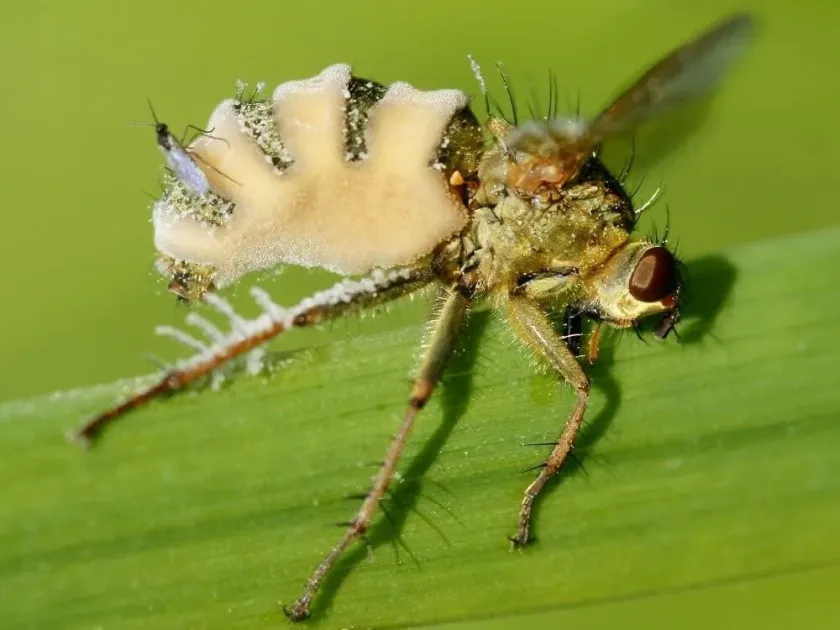
Externally, affected individuals are often found fixed to leaves or stems in unnatural poses, remaining attached to the substrate by the fungus's rhizoids.
For identification in the field, specialists use microscopic analysis of the body cavity contents, where characteristic conidia and mycelial strands are detected.
What it damages
Entomophthorales do not damage crops directly, as they are entomopathogens rather than phytopathogens. In fact, they are natural regulators of pest population density.
The primary targets of these fungi include aphids, whiteflies, leafhoppers, thrips, and various caterpillar species that damage cereals, fruit trees, and vegetables.
The mass spread of the fungus within pest populations allows for a significant reduction in agroecosystem pressure without the use of chemical pesticides.
Fungi of this order are especially effective in greenhouses, where a controlled microclimate promotes their active development and rapid infection of all pests.
The use of such bioagents helps preserve entomophages (beneficial insects) in the field, provided the fungal species exhibits selective action.
When it appears
The peak activity of Entomophthorales occurs during periods of high relative humidity and moderate temperatures, ranging from 18 to 25 degrees Celsius.
Frequent rainfall or fog in the summer creates ideal conditions for fungal sporulation, which leads to outbreaks of epizootics among insects.
The fungal life cycle includes a resting spore stage that can survive in the soil or plant debris for several months, enduring unfavorable conditions.
Conidia are dispersed both passively by air currents and raindrops, and actively, when the fungus discharges spores up to several centimeters to infect healthy individuals.
The speed of infection across the entire pest population under favorable weather conditions can take from 5 to 10 days.
Signs of infestation
The primary sign is the sudden mass death of pests, where their bodies are covered with a fine whitish or grayish dusting of spores.
Affected insects turn brown or dark, their cuticles become brittle, and they can easily disintegrate upon touch.
On stems and the undersides of leaves, one can notice "frozen" insects that are firmly attached to the surface due to the developed fungal rhizoids.
If the pest is an aphid, one may notice a characteristic "bloating" of the insect's abdomen before death, caused by the intensive growth of mycelium inside the host.
The absence of typical pest activity despite their visual presence on the plant often indicates the development of an entomophthorosis epizootic.
Control measures
To maintain natural populations of Entomophthorales, it is necessary to avoid the excessive use of broad-spectrum fungicides that suppress beneficial microflora.
Creating a favorable microclimate, including misting in greenhouses during morning hours, stimulates the development of natural infection centers among insects.
On an industrial scale, there are products based on cultures related to Entomophthorales, but their application requires strict adherence to temperature and humidity regimes.
The preservation of shelterbelts and zones with natural vegetation around fields is recommended, as they serve as reservoirs for fungal spores and beneficial entomophages.
- Ensuring humidity above 70% to activate the fungus
- Refraining from blanket chemical pesticide applications
- Monitoring pest numbers to assess natural population decline
- Using biological agents as a complement to natural control factors
Taxonomy
- Latin name
- Empusa
- Family
- Empusidae
- EPPO code
- EMPUSP
Discussion
No discussions yet — be the first.