
Cockroach wasp
Dolichurus
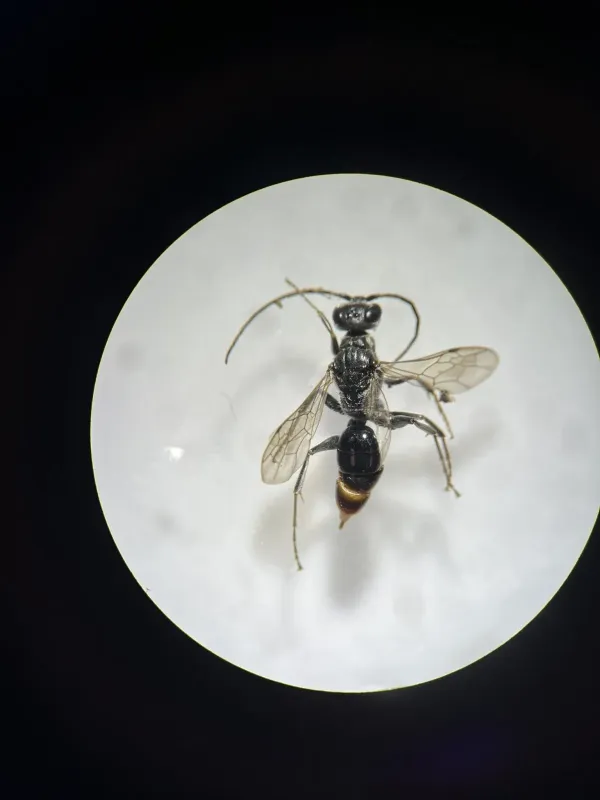
Description
How to identify
The cockroach wasp (genus Dolichurus) is a member of the Ampulicidae family within the Hymenoptera order. They are small, dark-colored wasps, often with a metallic sheen, evolved for specialized predatory behavior.
These wasps are solitary hunters rather than social insects. They possess morphological adaptations, such as slender bodies, that allow them to enter narrow crevices to track and paralyze their prey.
Unlike some other Hymenoptera, they do not build communal nests but instead utilize hidden spaces in soil or debris to rear their larvae on paralyzed cockroaches.
In an agricultural context, they are easily distinguished by experts through wing venation patterns and specific thoracic structures, separating them from plant-feeding insects.
Recognizing these wasps is essential for crop scouts to differentiate between potential biological control agents and true phytophagous pests that require intervention.
What it damages
The cockroach wasp causes absolutely no damage to crops. It is not a phytophagous insect and does not consume plant parts such as leaves, stems, or fruits, nor does it affect plant growth.
As a predatory wasp, its role is to regulate populations of cockroaches, which can occasionally become a nuisance in storehouses or greenhouse facilities, making them beneficial rather than harmful.
Any plant damage observed in proximity to these wasps is strictly due to other environmental stressors or different pest species, as Dolichurus has no interest in plant tissue.
Agronomically, this species is classified as an entomophage. Their presence indicates a healthy, functioning ecosystem where natural biological controls are at work.
Therefore, there is no economic threshold for damage related to the cockroach wasp, and they should be regarded as a valuable component of the local fauna.
When it appears
Adult Dolichurus activity typically spans the warmer months, beginning in late spring and extending through early autumn, depending on the local climate and temperature gradients.
The life cycle is closely linked to the environmental temperature, which dictates the activity levels of the wasps and their prey. Warmer conditions generally lead to increased foraging efficiency.
Overwintering usually occurs in protected environments, such as the soil or dense plant matter, where they reside in the larval or pupal stage until conditions permit emergence in the spring.
The timing of their emergence is synchronized with the activity of their hosts, ensuring that larvae have an adequate supply of food once they hatch from their eggs.
In greenhouses where temperatures remain consistent year-round, these wasps may show prolonged activity periods, provided that the cockroach prey population is present.
Control measures
There are no control measures recommended for the cockroach wasp, as it is a beneficial insect. Eradication efforts would be counter-productive to integrated pest management (IPM) goals.
To preserve these entomophages, growers should prioritize the use of selective insecticides that do not target beneficial Hymenoptera when managing primary crop pests.
Maintaining field margins and avoiding excessive soil disturbance can help protect their overwintering habitats, thereby supporting long-term biological suppression of pests.
Integrated strategies should focus on sustainable agricultural practices that minimize chemical exposure, ensuring the survival and proliferation of natural predators like the cockroach wasp.
- Use selective biological pesticides.
- Preserve natural habitats for beneficials.
- Prioritize IPM to reduce pesticide reliance.
Taxonomy
- Latin name
- Dolichurus
- Order
- Hymenoptera
- Family
- Ampulicidae
- EPPO code
- DOLHSP
Discussion
No discussions yet — be the first.