
Emerald cockroach wasp
Ampulex compressa
Description
How to identify
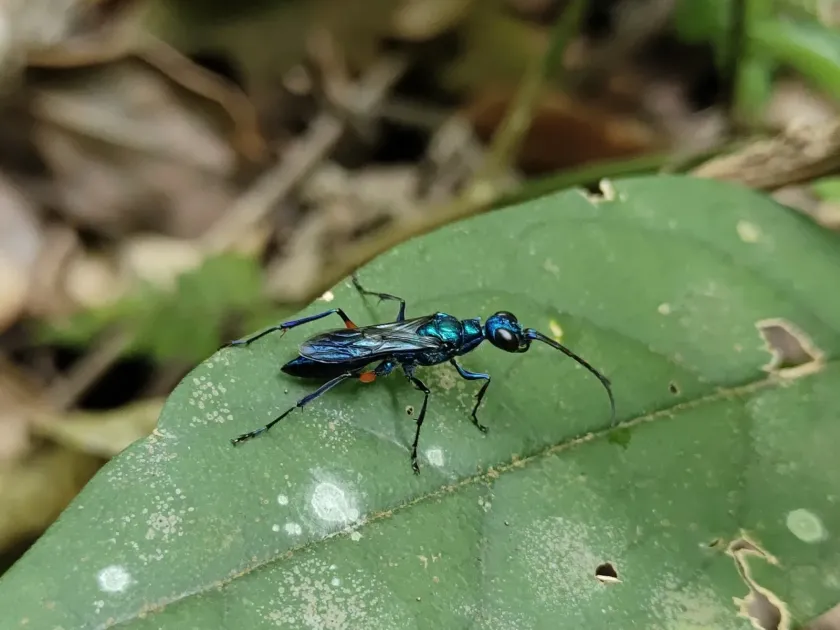
The emerald cockroach wasp, known as Ampulex compressa, belongs to the family Ampulicidae within the order Hymenoptera. This insect is easily identified by its brilliant, metallic green or blue iridescent body.
Adult females are typically larger than males, reaching lengths of about 20–22 mm. Their anatomy is highly specialized for hunting cockroaches, which are their primary hosts.
This species is mainly distributed in tropical and subtropical regions. In cooler climates, it can only thrive within artificial environments such as greenhouses or heated indoor facilities.
It is not a phytophagous pest as it does not consume plant tissues. Instead, it is an specialized parasitoid that preys on cockroaches, playing a niche role in the local ecosystem.
Correct identification is based on their unique metallic coloration and specific hunting behaviors, which are often observed in areas infested with cockroaches.
What it damages
This wasp does not cause direct physical damage to crops, stems, leaves, or roots. It is not an herbivore and lacks the mouthparts to damage vegetation.
The ecological impact is primarily related to its interaction with cockroach populations. In some cases, it may interfere with established integrated pest management (IPM) programs by competing with other beneficial insects.
In large-scale agricultural facilities, their presence is usually considered a minor issue, as they do not threaten yield quality or plant health.
However, the presence of these wasps indicates an existing cockroach infestation, which might be a more significant threat to the sanitary standards of the facility.
There is no economic damage to agricultural commodities associated with this species, making control efforts optional rather than mandatory.
When it appears
Activity is highly dependent on ambient temperatures and humidity levels. They prefer warm, stable climates typical of tropical regions or greenhouse environments.
In temperate zones, they do not survive outdoors during winter months, and their lifecycle is effectively halted by frost and cold weather.
Within protected structures like greenhouses, they can be active year-round if temperatures remain consistently above 25°C, allowing for continuous reproduction.
The development from egg to adult takes approximately 6 to 8 weeks, which enables the species to persist in suitable habitats if hosts are available.
The peak activity period for hunting and nesting usually aligns with the seasons when cockroach activity is highest, ensuring a steady supply of hosts for their larvae.
Signs of infestation
The primary evidence of their presence is the discovery of paralyzed cockroaches that remain motionless in sheltered areas such as corners, storage sheds, or near greenhouse structures.
Nesting sites, characterized by small burrow holes in the soil or in crevices of wooden structures, are clear indicators that the wasps have established a colony.
Adult wasps are often seen patrolling the ground in areas with high humidity and abundant debris, which are preferred by their prey.
- Presence of immobile cockroaches in non-obvious locations.
- Small, circular entrance holes in soil or wood surfaces.
- Sudden local decline in the cockroach population within a greenhouse setting.
Monitoring should be focused on damp, hidden locations where both the wasps and their hosts find suitable conditions for survival.
Control measures
Control measures are rarely necessary for plant protection, as the wasp poses no threat to crops. If desired, management focuses on reducing the cockroach population.
Physical exclusion, such as sealing cracks and crevices in structures, effectively prevents the wasps from establishing nesting sites.
Light traps can be utilized to reduce the adult wasp population in indoor facilities without the widespread use of chemical insecticides.
Sanitation practices that remove food sources for cockroaches will naturally cause the wasp population to decline due to the lack of available hosts.
Avoid excessive chemical spraying, as this can negatively impact beneficial insects and pollinators that are essential for the overall health of the greenhouse ecosystem.
Taxonomy
- Latin name
- Ampulex compressa
- Order
- Hymenoptera
- Family
- Ampulicidae
- EPPO code
- AMPXCO
Discussion
No discussions yet — be the first.