
Dolerus unicolor
Dolerus unicolor
Description
How to identify
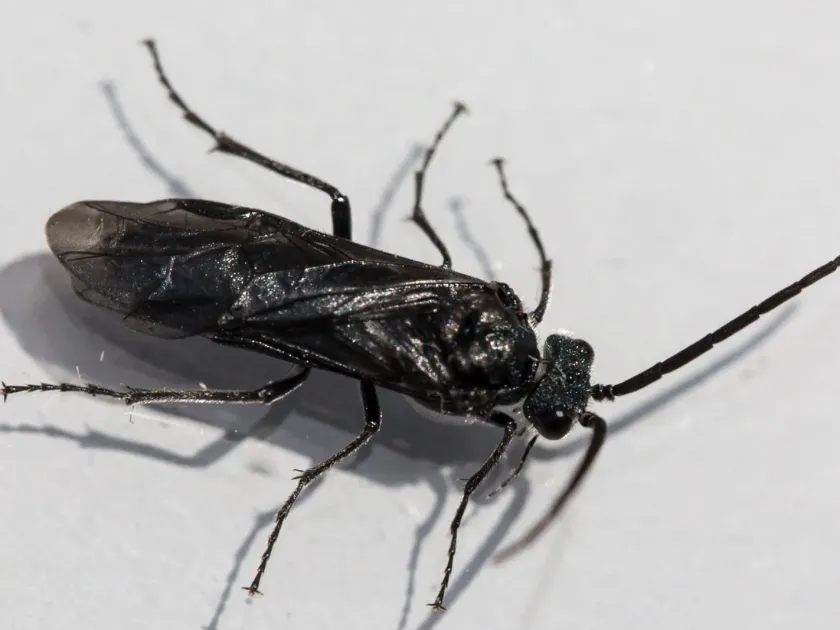
Dolerus unicolor is a member of the Hymenoptera order and the Tenthredinidae family. These insects are commonly referred to as sawflies, characterized by their shiny black appearance and a body length of about 8–10 mm.
The adults are recognizable by their transparent wings with dark veins. They are often found on cereal crops during the early stages of the growing season.
The larvae, often called false caterpillars, have a yellowish-green color with a distinct darker stripe along the back and multiple sets of prolegs.
The life cycle consists of one generation per year. Larvae overwinter in the soil within protective cocoons, where they pupate early in the spring.
Adults emerge from the soil in spring, coinciding with the sprouting and active growth phases of winter and spring wheat or rye.
What it damages
This pest primarily affects cereal crops, including wheat, barley, and rye. It is the larval stage that causes the most significant damage to the plants.
The larvae feed voraciously on the leaf blades, starting from the margins. If left uncontrolled, they can strip leaves completely, leaving only the midribs.
Such defoliation reduces the plant's capacity for photosynthesis, leading to stunted growth, poor grain filling, and an overall decrease in yield.
The damage is particularly critical during the vegetative growth stages when the plant needs maximum foliage area to develop its reproductive organs.
High infestation levels can lead to patchy fields and significant economic losses if the population is not monitored and suppressed early.
Signs of infestation
Key indicators of infestation include irregular or scalloped leaf edges, which are typical of sawfly larval feeding patterns observed during field scouting.
When disturbed, the larvae exhibit a characteristic defensive behavior, curling their bodies into a spiral shape on the leaves.
The presence of frass (larval excrement) on the leaves or the soil surface is a clear sign of active feeding and a high population density.
Heavily affected crops show signs of yellowing or desiccation, as the plants struggle to recover from the loss of green tissue and nutrient depletion.
Visual inspection of the field reveals uneven plant height and thin stands, where clusters of larvae have consumed the vegetative mass.
Control measures
Crop rotation is the most effective cultural practice to disrupt the life cycle of Dolerus unicolor, preventing the buildup of overwintering populations.
Deep plowing during the fall or early spring effectively destroys the cocoons by burying them or exposing them to environmental conditions and predators.
When infestation exceeds the economic threshold, targeted insecticide applications are recommended to control the larval population on the crops.
Biological control, facilitated by encouraging beneficial predators and parasitic wasps, plays a vital role in natural population management.
Frequent field scouting and monitoring are essential to identify early outbreaks, allowing for timely intervention before the pest reaches destructive levels.
Taxonomy
- Latin name
- Dolerus unicolor
- Order
- Hymenoptera
- Family
- Tenthredinidae
- EPPO code
- DOLEUN
Discussion
No discussions yet — be the first.