
Black wheat sawfly
Dolerus tritici
Description
How to identify
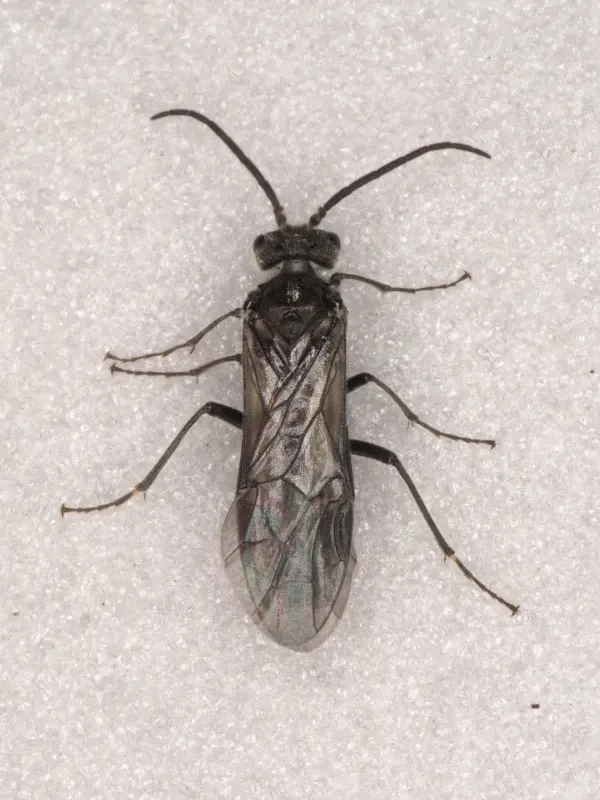
The black wheat sawfly belongs to the order Hymenoptera, family Tenthredinidae. Adult insects are 9–11 mm long with a shiny black body and metallic luster.
The larvae, known as false caterpillars, are yellowish-green with a dark head. They have a distinct wrinkled body and possess a robust chewing mouthpart used for feeding on leaves.
The species completes one generation per year. Larvae overwinter in the soil at a depth of 10–15 cm within protective silk cocoons.
Adult emergence typically occurs in spring, aligning with the jointing stage of cereal crops.
Females use their saw-like ovipositor to insert eggs into the epidermis of stems or leaf sheaths.
What it damages
This pest mainly attacks wheat crops, although it can also be found on barley and rye depending on local agro-ecological conditions.
Larvae cause damage by feeding on leaf tissues, initially creating small holes and later eating leaf margins, leaving only the veins.
Significant infestations can cause defoliation, reducing the photosynthetic capacity of the plants and leading to poor kernel development.
Stems damaged during the early growth stages may become brittle, increasing the risk of lodging before harvest time.
Crop losses are most pronounced in years with cool, damp springs that favor the prolonged development of the larvae.
When it appears
Adults emerge from the soil when temperatures are favorable, usually starting in mid-to-late spring depending on the latitude.
Larval activity reaches its peak during the late vegetative stages of cereals, particularly during stem elongation and early heading.
After finishing their feeding cycle, larvae burrow into the soil to prepare for summer and winter diapause.
Weather conditions significantly impact the timing, with moisture being a key factor for the survival and distribution of the larvae.
The emergence period is often staggered, meaning multiple larval instars can be observed in a field at the same time.
Signs of infestation
The most visible signs of infestation are ragged leaf edges and irregular holes appearing in the leaf blades of wheat plants.
Examination of the stems may reveal small scars or blisters where the female sawfly inserted her eggs.
As damage progresses, the leaves may turn yellow and wither prematurely, leading to an overall thinning of the crop stand.
Severely infested plants exhibit stunted growth, reduced height, and stunted heads, which ultimately affects the final yield quantity.
Field scouting in the early morning or evening hours usually allows for the direct observation of larvae on the leaves.
Control measures
Cultural practices like deep plowing after harvest effectively destroy overwintering cocoons and disrupt the life cycle of the pest.
Implementing proper crop rotation and maintaining clean fields by removing volunteer plants can significantly lower population pressure.
Chemical control involving the use of systemic or contact insecticides is recommended when population densities exceed economic injury levels.
- Selecting resistant or vigorous crop varieties to ensure faster development.
- Monitoring fields during the jointing stage for early detection.
- Applying insecticides responsibly to minimize harm to beneficial insects and predators.
Early identification of larvae in the field is crucial for determining the timing and necessity of chemical interventions.
Taxonomy
- Latin name
- Dolerus tritici
- Order
- Hymenoptera
- Family
- Tenthredinidae
- EPPO code
- DOLETR
Discussion
No discussions yet — be the first.