
Barley sawfly
Dolerus hordei
Description
How to identify
The barley sawfly, known scientifically as Dolerus hordei, is a member of the Hymenoptera order and the Tenthredinidae family. Adults are small insects, typically measuring 8 to 10 mm in length.
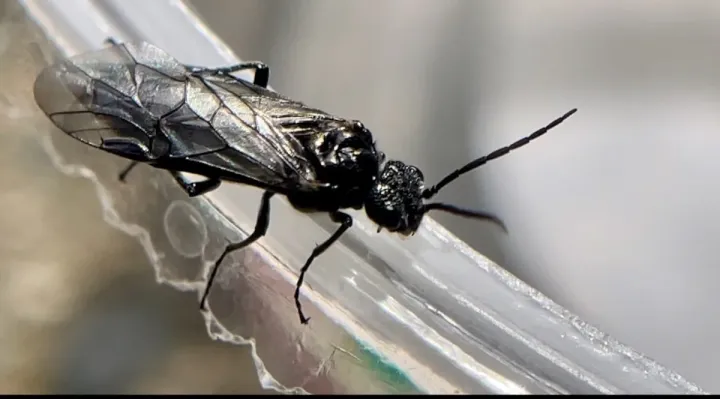
The adult insect has a shiny black body and clear wings with distinct dark venation, which serves as a reliable diagnostic feature for field identification.
The larvae, often referred to as false caterpillars, are greenish-gray or yellowish in color, blending in well with the foliage of cereal crops.
The body of the larva is covered with tiny warts; when disturbed, it characteristically curls into a spiral shape to defend itself from predators.
The life cycle involves complete metamorphosis, with the larva being the primary overwintering stage, residing in cocoons within the topsoil.
What it damages
Barley sawfly larvae primarily infest cereal crops, showing a strong preference for barley, wheat, and rye during their peak activity periods.
Wild grasses, particularly couch grass (Elymus repens), serve as alternative hosts and reservoirs for the pest when primary cereal crops are unavailable.
Early-stage larvae feed on the leaf parenchyma, creating small window-like patches on the leaves without fully consuming the epidermis at first.
As the larvae mature, they become increasingly voracious, consuming entire leaf sections from the margins and leaving behind only the tough leaf veins.
Heavy infestations lead to a significant reduction in green leaf area, which severely limits the plant's photosynthetic capacity and reduces grain yield.
When it appears
Adults emerge from the soil in early spring, synchronized with the onset of the jointing stage in winter cereal crops, when temperatures are favorable.
Females lay eggs by using their saw-like ovipositor to cut slits into the leaf tissue, usually along the veins, making the eggs difficult to detect initially.
The larval development phase is rapid and coincides with the tillering and jointing growth stages of the cereal plants, which are crucial for yield formation.
After completing their feeding cycle in late spring, the larvae burrow into the soil to pupate and remain in diapause until the following spring.
Warm, moist spring weather is generally optimal for the survival of eggs and the establishment of larvae, potentially leading to higher pest populations.
Signs of infestation
The earliest signs of infestation are small translucent patches on the leaves, which expand into irregular holes as the larvae grow larger.
Marginal defoliation is a key indicator, where parts of the leaf blades are consumed, often leaving a ragged appearance on the edges of the plants.
During cool or overcast conditions, larvae can be spotted resting on the leaves; in hot weather, they tend to hide near the stem base or in the soil.
In fields with high pest pressure, plants may show signs of yellowing, wilting, or stunted growth, making the field look noticeably uneven and less vigorous.
Significant damage to the foliage reduces the plant's ability to fill the grain, resulting in lower hectoliter weight and overall poor harvest quality.
Control measures
Crop rotation is the primary defense strategy, as it effectively disrupts the barley sawfly life cycle by limiting the availability of host plants in the area.
Deep autumn plowing is a highly recommended agricultural practice to expose the cocoons in the soil, leading to the desiccation and death of the pupae.
Effective weed management, focusing on the eradication of couch grass and other wild grasses, is essential to minimize the pest's reservoir habitats.
When the economic threshold for pest density is reached, the application of registered contact or systemic insecticides is necessary to prevent significant yield losses.
Consistent field scouting and monitoring for adults in early spring allow agronomists to time insecticide applications accurately for maximum effectiveness.
Taxonomy
- Latin name
- Dolerus hordei
- Order
- Hymenoptera
- Family
- Tenthredinidae
- EPPO code
- DOLEHO
Discussion
No discussions yet — be the first.