
Black sawfly
Dolerus collaris
Description
How to identify
The Black sawfly (Dolerus collaris) is a member of the Tenthredinidae family within the Hymenoptera order, widely recognized as a significant pest of cereal crops.
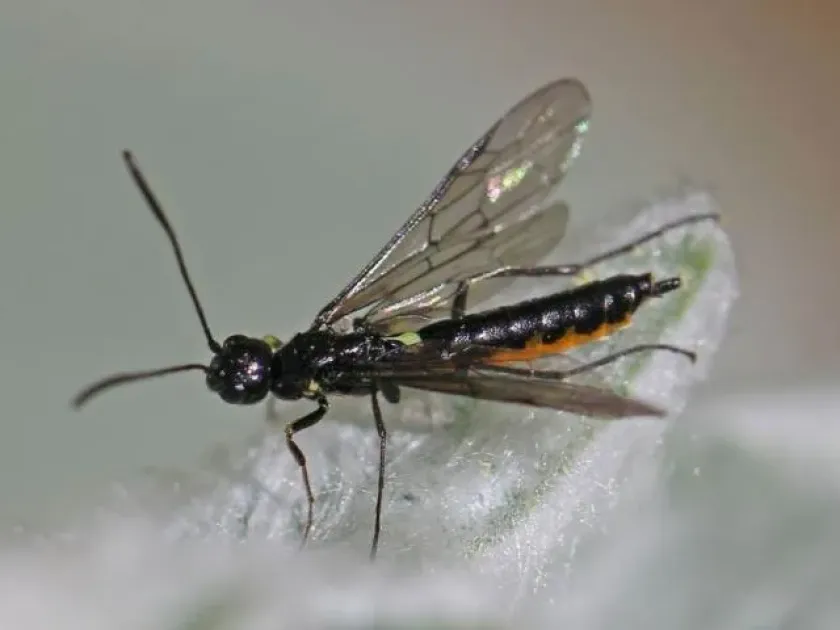
Adult insects are typically 8–10 mm in length, possessing a glossy black body with transparent, membranous wings, which allows for distinct identification in the field.
The larvae, known as false caterpillars, have a greenish-grey or brownish color with a dark head and are equipped with three pairs of thoracic legs.
Adult females utilize a saw-like ovipositor to make precise incisions in plant tissues, depositing their eggs individually within the leaves of host plants.
Accurate identification involves observing the larval behavior and specific wing vein patterns, which differentiate this species from other related sawflies.
What it damages
Dolerus collaris primarily targets cereal crops, including wheat, rye, and barley, causing direct damage to the plant's vegetative parts during the spring season.
Larvae consume the leaf blades, typically starting from the edges and progressing towards the central vein, often leaving only the skeleton of the leaf.
Severe infestations can lead to substantial reduction in leaf area, which hinders photosynthesis and negatively impacts grain filling and crop maturation.
The loss of flag leaves, which are critical for yield, results in stunted growth and lower grain quality, posing a significant risk to the overall harvest.
Additionally, physical damage to the leaves provides entry points for various bacterial and fungal pathogens, potentially leading to secondary infections.
When it appears
The emergence of adult sawflies occurs in early spring, generally between April and May, coinciding with the active tillering stage of winter cereal crops.
The mating and egg-laying period is highly dependent on environmental temperature, with warmer spring weather leading to faster population development.
Larvae remain active throughout the late spring months, passing through several instars before eventually entering the soil for pupation.
The insect overwinters in the soil as a larva or pupa within a protective cocoon at a depth of 10 to 15 centimeters, remaining dormant until the next season.
With only one generation per year, the management strategy must focus on proactive monitoring during the early spring developmental stages.
Signs of infestation
The initial signs of a Black sawfly infestation include small, irregular holes or notches on the leaf margins, which serve as clear indicators of larval feeding.
During the day, larvae may be difficult to spot, but they often react to physical disturbance by coiling into a spiral shape on the surface of the leaf.
A widespread infestation is characterized by a "riddled" appearance of the crop canopy, with large portions of foliage consumed by the growing larvae.
Stunted growth, yellowing foliage, and reduced plant vigor are common secondary symptoms caused by the sustained feeding pressure of the larvae.
Field inspection should also look for the presence of larval frass on the leaves and at the base of the plant, which confirms the recent activity of the pest.
Control measures
Effective management begins with proper crop rotation, which breaks the lifecycle by reducing the availability of preferred host plants for the next generation.
Deep autumn plowing is a highly recommended practice, as it disrupts the soil, exposing the overwintering larvae to predators and harsh environmental conditions.
When the economic injury threshold is met, the application of registered insecticides is necessary to prevent significant yield losses during the peak feeding phase.
Weed management is essential, as grasses such as couch grass act as natural reservoirs for the pest when the main crops are not available.
- Implementation of biological control using natural predators like ichneumonid wasps that parasitize the larvae.
- Timed insecticide applications to target young larvae before they burrow into the soil for pupation.
Taxonomy
- Latin name
- Dolerus collaris
- Order
- Hymenoptera
- Family
- Tenthredinidae
- EPPO code
- DOLECO
Discussion
No discussions yet — be the first.