
Hazelnut rust mite
Diptacus gigantorhynchus
Description
How to identify
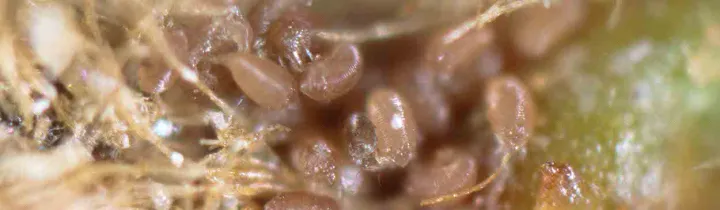
The hazelnut rust mite (Diptacus gigantorhynchus) is a microscopic pest belonging to the Eriophyidae family. These mites have a slender, elongated, worm-like body that is yellow or white, making them nearly invisible to the naked eye without magnification.
These mites overwinter as adults, typically hiding within the bud scales or in the bark crevices of hazelnut shoots. As temperatures rise during the spring, they emerge and migrate to the newly unfolding leaves to feed and begin their reproductive cycle.
The life cycle of the hazelnut rust mite is very short, allowing for multiple generations to develop throughout a single growing season. Their rapid reproduction is supported by warm and moderately humid weather conditions, which are ideal for population explosions.
Dispersal occurs primarily via wind currents, which carry the mites from infested trees to healthy ones. This mode of spread makes it challenging to contain infestations within an orchard once they become established and reach a high density.
Because of their specific biology, these mites are highly specialized to the hazelnut (Corylus) genus. Their survival strategies, including the ability to utilize various parts of the plant during different times of the year, ensure their persistence in orchards.
What it damages
The primary host for this pest is the hazelnut tree (Corylus avellana). Mites feed by piercing the plant tissues and extracting cell sap, which leads to significant physiological stress for the tree and direct damage to its vegetative and reproductive organs.
Feeding damage causes chlorosis, leaf deformation, and stunted growth. The affected leaves often curl or develop irregular yellow-to-brown discoloration, which reduces the tree's photosynthetic efficiency and weakens its overall metabolic capacity.
Heavy infestations can lead to premature leaf drop, which significantly reduces the tree's vigor and its ability to store energy for the subsequent season. This loss of foliage is particularly damaging if it occurs mid-season, as it impacts nut development.
The damage to buds is particularly problematic, as it may result in poor fruit set or the development of weak, non-productive shoots. This directly reduces the commercial yield and can lower the overall quality of the nut harvest.
Over several years, untreated infestations can lead to general tree decline, making them more susceptible to environmental stressors and other opportunistic diseases. Managing these mites is essential for maintaining the long-term productivity of a hazelnut orchard.
Signs of infestation
Key indicators of infestation include the appearance of chlorotic spots or bronzing on the upper surface of the leaves. As the infestation progresses, these areas may become necrotic, and the overall leaf color often appears dull or scorched.
Leaf distortion is another hallmark of their presence, with many leaves becoming wavy, crinkled, or curled along the midrib. This deformation is often most visible on the new growth during the active spring and early summer periods.
Under magnification, one might notice a dusty or silvery residue on the underside of the leaf, which is a combination of mite cast skins and debris from their feeding activities. The presence of mites themselves can also be confirmed with a high-powered hand lens.
In severe cases, the tree may exhibit stunted shoot growth and reduced internode length. The lack of healthy foliage makes the crown appear thin, and the tree may lose its typical vibrant green color, looking pale or generally unhealthy.
Monitoring the undersides of leaves near the leaf veins is the most reliable way to spot early infestations. Early detection is critical, as once the population has spread throughout the entire crown, the damage becomes much harder to mitigate effectively.
Control measures
Successful management begins with good orchard hygiene, such as removing infested shoots through selective pruning. Properly disposing of infested plant material helps to reduce the overwintering population density of the mites in the field.
Acaricides are the primary chemical tool for controlling these pests. Applications should be timed to coincide with the period of spring bud break when the mites emerge from their overwintering sites, as this is when they are most vulnerable to contact treatments.
It is essential to rotate acaricide products with different modes of action to prevent the development of pesticide resistance. Always ensure full coverage of the foliage, particularly the undersides of the leaves where the mites are most active.
Biological control methods, such as encouraging natural predators like predatory mites, can be effective in integrated pest management (IPM) programs. These predators can significantly dampen mite populations without the need for frequent chemical sprays.
Ensuring proper irrigation and plant nutrition helps the hazelnut trees recover from feeding damage. A healthy, vigorous tree is more resilient to pest pressure and can maintain production even when mite populations are present at low levels.
Taxonomy
- Latin name
- Diptacus gigantorhynchus
- Order
- Mites
- Family
- Diptilomiopidae
- EPPO code
- DIPTGI
Discussion
No discussions yet — be the first.