
Western corn rootworm
Diabrotica longicornis
Description
How to identify
The Western corn rootworm, scientifically known as Diabrotica virgifera virgifera, is a major agricultural pest belonging to the leaf beetle family, Chrysomelidae.
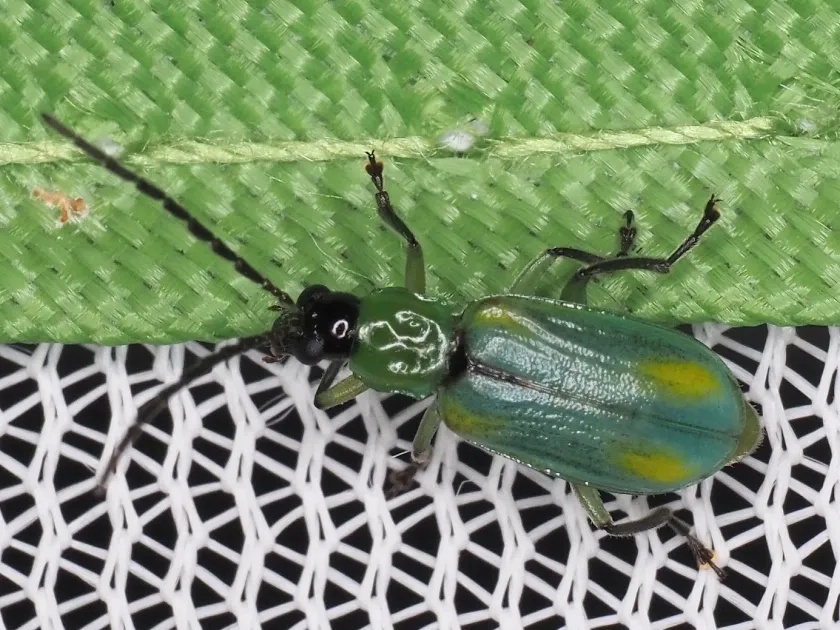
Adult beetles are approximately 5–7 mm long, characterized by their yellowish-green color with black stripes on the elytra, though patterns can vary significantly.
The larvae are slender, creamy-white in color with a brown head capsule, living entirely underground where they feed on the root systems of corn plants.
The life cycle involves four stages: egg, larva, pupa, and adult. There is generally one generation per year, with eggs overwintering in the soil.
Due to its high adaptability and rapid reproduction rate, it has become a primary economic threat to maize production across North America and Europe.
What it damages
Larval feeding causes the most severe damage by pruning the root system, which impairs the plant's ability to take up water and essential nutrients from the soil.
Root damage significantly reduces plant stability, leading to "lodging" or "goosenecking," where the stalks bend over, making mechanical harvesting impossible.
Adult beetles feed on corn silks, pollen, and leaves. By consuming the silks, they disrupt the pollination process, resulting in poorly filled ears and lower grain yield.
The wounds left by feeding larvae provide entry points for soil-borne pathogens, which can lead to various root and stalk rot diseases, further weakening the crop.
Economic losses are often compounded by both yield reduction due to poor pollination and the increased cost of harvesting lodged crops in infested fields.
When it appears
Egg hatch usually occurs in late spring, around May or June, as soil temperatures rise, which coincides with the critical early growth stages of the corn crop.
Larval development proceeds through three instars until pupation, which typically happens in the soil during the summer months of June and July.
Adult beetles emerge in July and August, coinciding with the flowering and pollination stage of the corn plant, which is the preferred food source for the adults.
Egg-laying begins in mid-summer and continues until the first frosts, with females depositing eggs into the soil to ensure the next year's generation.
Understanding these seasonal dynamics is essential for timing scouting operations and applying insecticide treatments at the most vulnerable stages of the pest.
Signs of infestation
The most visible sign of an infestation is the irregular leaning or lodging of corn plants, which often occurs after heavy wind or rain events.
Silks that appear clipped or truncated near the ear tip indicate the presence of adult beetles feeding during the silking stage of development.
Scouting for adult beetles on leaves, tassels, or silk during the day can confirm their presence and determine the potential for future egg deposition.
Stunted plant growth or uneven maturity across a field, despite adequate irrigation or fertilizer, can point to extensive root system damage by larvae.
Yellow sticky traps are commonly used as an effective diagnostic tool to monitor adult beetle population density throughout the growing season.
Control measures
Crop rotation is the most effective cultural practice; rotating corn with non-host crops like soybeans or small grains significantly disrupts the pest's life cycle.
Soil-applied insecticides during planting can protect the young roots from larval damage, ensuring the plant establishes a strong foundation.
Foliar insecticide applications directed at adults during the silking phase can prevent excessive silk feeding and minimize the impact on grain yield.
Planting transgenic hybrids expressing proteins that target rootworm larvae has become a standard approach in areas with high pest pressure.
- Implement crop rotation
- Use soil-applied insecticides
- Monitor with sticky traps
- Adopt transgenic resistant hybrids
Taxonomy
- Latin name
- Diabrotica longicornis
- Order
- Coleoptera (beetles)
- Family
- Chrysomelidae
- EPPO code
- DIABLG
Discussion
No discussions yet — be the first.