
Crownvetch gall midge
Dasineura coronillae
Description
How to identify
The crownvetch gall midge (Dasineura coronillae) belongs to the order Diptera, family Cecidomyiidae. This tiny insect is inconspicuous in its adult phase, typical of most members of the gall midge family.
Larvae exhibit typical morphology for this family: they are legless, spindle-shaped, and possess a well-developed mouth apparatus adapted for feeding on plant tissues.
Pupation occurs either inside the galls formed by the insect or in the soil, depending on the generation and specific environmental conditions of the region.
Identifying the adult specimen without specialized laboratory equipment is extremely difficult, so identification is usually based on the specific damage done to plant tissues.
The life cycle is closely synchronized with the phenological stages of the host plant, ensuring optimal conditions for the feeding and development of the next generation of the pest.
What it damages
The primary host plant for this species is crownvetch (Coronilla), which is often used as a forage crop or a honey plant in various agricultural systems.
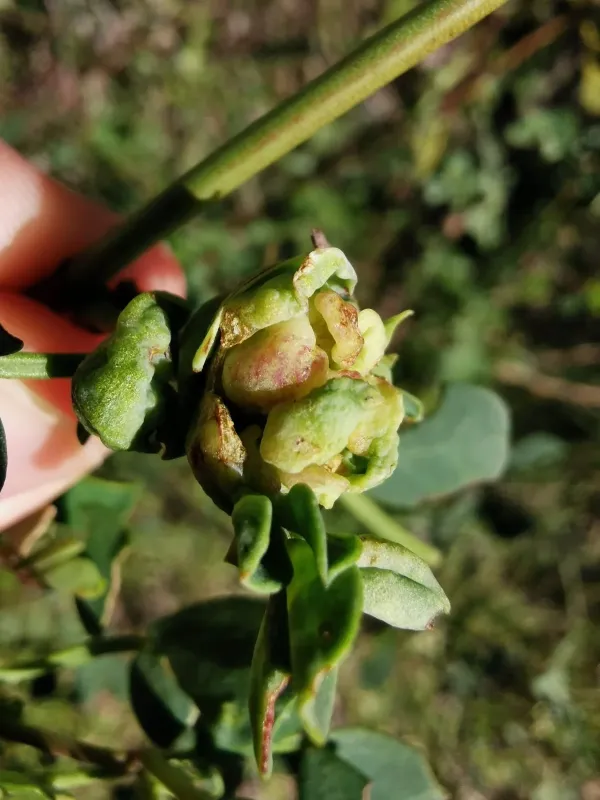
The pest causes damage through the formation of specific deformities known as galls, within which the larvae develop, extracting nutrients from the plant's tissues.
The damage primarily affects the generative organs of the plant, leading to significant losses in seed yield for the affected agroecosystem.
Beyond direct destruction of the ovaries, the activity of these gall midges weakens the plant's overall health, making it more susceptible to other plant pathogens.
Mass reproduction of the pest during periods of high humidity can lead to losses of up to 30-50% of the crownvetch seed crop in infested fields.
Signs of infestation
The main indicator of infestation is the presence of characteristic swellings (galls) on leaves, shoots, or inflorescences of the host plant.
When these deformities are dissected, small yellowish or orange larvae can be found inside, which serves as definitive proof of Dasineura coronillae activity.
Visually, affected plant areas may undergo color changes, premature wilting, or deformation, which are easily noticed during regular field inspections.
The failure to form full-sized pods and early pod drop are often indicative of the hidden activity of larvae inside the flower buds.
Gradual drying of shoot tips during the peak flowering period may also serve as an indirect sign of pest activity within the crop.
Control measures
Agrotechnical practices include deep autumn plowing, which helps destroy pupae overwintering in the topsoil or among crop residues.
An essential element is maintaining proper crop rotation and spatial isolation of crownvetch fields from areas used in previous years where high pest density was recorded.
Chemical control should be applied during the period of adult flight and egg-laying, using registered systemic insecticides with a broad spectrum of activity.
Regular crop monitoring using yellow sticky traps is crucial for accurately determining the optimal timing for protective interventions.
Timely removal and destruction of crop residues after harvest are critical steps to break the pest's developmental cycle for the following season.
Taxonomy
- Latin name
- Dasineura coronillae
- Order
- Diptera (flies)
- Family
- Cecidomyiidae
- EPPO code
- DASYCO
Discussion
No discussions yet — be the first.