
Dacryphalus
Dacryphalus
Description
How to identify
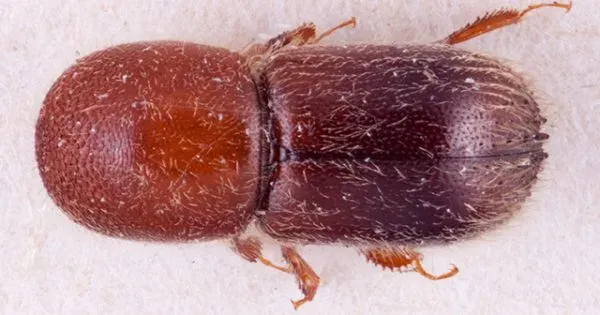
Dacryphalus is a genus of bark beetles belonging to the family Curculionidae, subfamily Scolytinae. These insects are small, typically measuring between 2 and 3 millimeters in length, with a cylindrical body adapted for life beneath tree bark.
Their color ranges from dark brown to black, providing camouflage within their natural environment. The head is often hidden by the pronotum, which is a classic feature of many bark-boring beetle species.
Larvae of Dacryphalus are legless and C-shaped, with a whitish or yellowish color. They remain inside the tree tissue for their entire development, feeding on the inner bark and cambium layers.
Identification often requires a microscope to examine the specific structure of the antennae and the teeth located on the elytra. Distinguishing between closely related species is essential for effective monitoring.
Both males and females are involved in the construction of maternal galleries, where the eggs are laid to ensure the survival and development of the offspring.
What it damages
Dacryphalus beetles primarily attack coniferous and broad-leaved trees. While they often target weakened or stressed trees, a large population can overcome the natural defenses of healthy trees.
The damage is caused by the construction of galleries under the bark, which destroys the cambium layer. This interrupts the flow of water and essential nutrients from the roots to the canopy.
These beetles also act as vectors for fungal infections. The tunnels they bore serve as entry points for pathogens, leading to wood decay and further weakening the structural integrity of the tree.
Damage symptoms usually become visible once the population has reached a significant level. The overall health of the tree declines rapidly, leading to crown dieback and potentially tree death.
In forestry and arboriculture, these pests are considered serious economic threats because they reduce the quality of timber and jeopardize the survival of young saplings.
When it appears
The active season for Dacryphalus typically begins in the spring when temperatures rise above 15 degrees Celsius. This is the period when overwintering adults emerge to find suitable host trees.
The life cycle includes the egg, larval, pupal, and adult stages. Depending on climatic conditions, these beetles can produce multiple generations in a single year, exacerbating their impact.
Adult beetles overwinter in the bark of infested trees or in the leaf litter at the base of the trunk. This strategy allows them to survive harsh winter conditions until the return of favorable weather.
The larval stage lasts for several weeks, followed by pupation within the galleries. By late summer or early autumn, the new generation of adults usually matures.
Monitoring the flight periods of adult beetles is critical for effective pest management, as this timing helps determine the most appropriate window for applying control measures.
Signs of infestation
The most reliable sign of an infestation is the presence of "frass," a fine sawdust-like material, found on the bark or at the base of the tree. This is produced as the beetles bore into the wood.
Entry holes, which appear as small pinpricks on the surface of the bark, are often visible upon close inspection. In some cases, the bark may start to loosen or peel away from the wood.
Crown symptoms include the yellowing or browning of needles or leaves. This indicates that the tree's vascular system is compromised, preventing proper hydration and nutrient distribution.
Resin flow or bleeding can occur on coniferous trees as a defensive reaction to the insect's entry attempt. This is often an early sign that the tree is trying to push the beetles out.
- Dead needles or leaves falling prematurely.
- Increased presence of woodpeckers on the tree trunk.
- Structural softening of the bark tissue.
Control measures
The primary control strategy is the sanitation of the forest area. This involves the timely identification, felling, and removal of infested trees before the beetles can emerge and spread.
Pheromone traps are highly effective for monitoring population dynamics and reducing the number of adult beetles through mass trapping. These are best used during peak flight periods.
Systemic insecticides may be used in nursery settings or for protecting valuable ornamental trees. These treatments are applied to protect the tree from colonization during high-risk times.
Improving tree vigor through proper irrigation, fertilization, and avoiding mechanical damage is the best long-term preventive measure against bark beetle attacks.
Biological control, which includes protecting natural predators like specific beetle-eating birds and parasitic insects, plays a vital role in maintaining ecological balance and controlling population explosions.
Taxonomy
- Latin name
- Dacryphalus
- Order
- Coleoptera (beetles)
- Family
- Curculionidae
- EPPO code
- DACRSP
Discussion
No discussions yet — be the first.