
Sowthistle gall midge
Cystiphora sonchi
Description
How to identify
The sowthistle gall midge (Cystiphora sonchi) belongs to the Cecidomyiidae family, commonly known as gall midges, within the order Diptera. These are delicate, tiny flies that resemble gnats, characterized by their fragile bodies and reduced wing venation.
The adult stage is short-lived, with the primary lifecycle taking place within the plant tissues. The larvae are small, legless, and maggot-like, specifically adapted to live inside the host plant's leaves, protected by the gall structures they induce.
What it damages
This species is highly host-specific, feeding almost exclusively on Sonchus arvensis (perennial sowthistle). Unlike typical agricultural pests, this midge does not feed on crops, making it a highly valued biological control agent.
By forming galls on the leaves, the larvae divert nutrients from the host plant, effectively stressing the weed. This reduction in the plant's overall vigor makes it a significant contributor to sustainable weed management programs.
When it appears
The insect follows the phenology of its host plant. It typically overwinters as a pupa in the soil, emerging in spring to locate young sowthistle rosettes or shoots as they become available for oviposition.
Multiple generations occur throughout the growing season, typically starting in late spring and continuing through early autumn. Warm and humid conditions are generally favorable for the development of each subsequent generation.
Signs of infestation
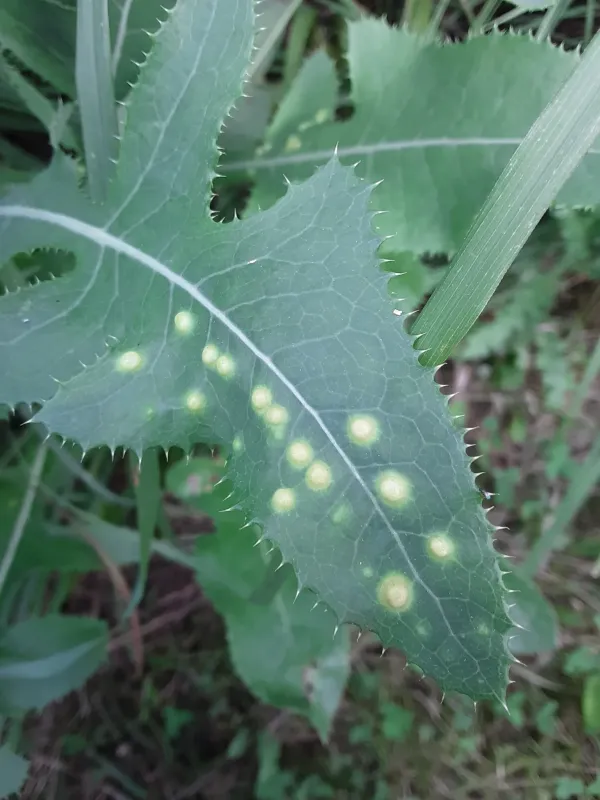
The most visible sign of infestation is the development of distinct, blister-like galls on the upper or lower leaf surfaces. These galls appear as small, raised circular bumps, often changing color from green to yellow or red.
As the larvae mature inside, the galls may become more prominent. Heavy infestations result in numerous galls per leaf, leading to tissue chlorosis, leaf deformation, and a visible decline in the health of the sowthistle patch.
Control measures
No control measures are necessary, as Cystiphora sonchi is considered a beneficial insect. In agricultural practices, it is often recommended to protect these midges by minimizing the use of non-selective pesticides.
Encouraging the presence of this midge is a part of conservation biological control. Integrated pest management strategies rely on such natural regulators to minimize reliance on synthetic chemical herbicides for weed suppression.
Taxonomy
- Latin name
- Cystiphora sonchi
- Order
- Diptera (flies)
- Family
- Cecidomyiidae
- EPPO code
- CYSTSO
Discussion
No discussions yet — be the first.