
Douglas fir twig weevil
Cylindrocopturus furnissi
Description
How to identify
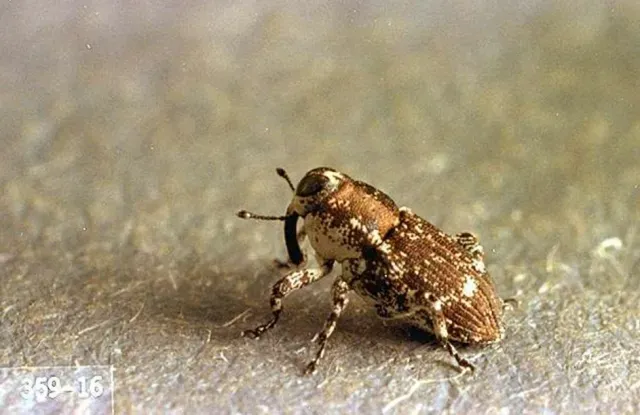
The Douglas fir twig weevil (Cylindrocopturus furnissi) is a small beetle belonging to the order Coleoptera and the family Curculionidae. These insects are typically 3–4 millimeters in length, characterized by a stout, robust body.
The adult weevils are dark brown to black in color, often covered with small light-colored scales that provide camouflage against the bark of host trees. They possess the characteristic long snout common to the Curculionidae family.
The larvae are legless, white or cream-colored grubs with a well-developed, brownish head capsule. They are specifically adapted for mining and feeding within the cambium layer beneath the bark.
Pupation occurs within small, oval-shaped cells created by the larvae inside the woody tissue. This stage allows the insect to safely undergo metamorphosis protected from predators and environmental stressors.
Adult beetles are active and capable of dispersing to nearby trees, which facilitates the spread of infestations across stands of Douglas firs and other susceptible conifer species.
What it damages
The primary host for this pest is the Douglas fir (Pseudotsuga menziesii). Young trees in nurseries and young plantations are particularly susceptible to attack due to their thinner bark.
In addition to Douglas firs, the weevil may attack other related conifer species depending on the local ecosystem and the availability of suitable host tissues for larval development.
The most severe damage is caused by the larvae, which feed on the cambium and phloem. This tunneling action disrupts the tree's vascular system, effectively cutting off the flow of water and nutrients to the distal parts of the branches.
If the infestation is extensive, it can lead to branch dieback or the death of the entire tree. Even if a tree survives, it often exhibits structural damage and reduced vigor, making it prone to secondary infections.
Economic impact is significant in forestry and nursery settings, where the loss of young planting stock results in financial losses and the need for costly replanting efforts.
When it appears
The life cycle of the Douglas fir twig weevil typically spans one to two years, influenced by regional climate conditions. Adults become active as temperatures rise during late spring and early summer.
Females lay eggs in small punctures made in the bark of thin branches. Upon hatching, the larvae immediately begin boring into the inner bark layers to feed and establish their galleries.
Larval development occurs throughout the summer months. As they grow, they enlarge their feeding galleries, which eventually become quite complex under the bark surface.
The insects overwinter as mature larvae within their galleries. They remain in a state of diapause until spring, when they resume activity to pupate and eventually emerge as adult beetles.
Because the development of individuals can be asynchronous, it is common to find multiple life stages present on a single tree, which complicates the timing of pest management operations.
Signs of infestation
Infestation is often first signaled by the appearance of small, circular exit holes in the bark of branches. These holes are created by emerging adults and are often accompanied by frass or wood dust.
A hallmark sign of damage is the flagging or discoloration of foliage. The needles on infested branches turn yellow, then reddish-brown, and eventually drop off as the branch dies.
When the bark is peeled back in infested areas, characteristic serpentine larval galleries can be observed. These galleries are typically filled with fine, packed wood particles and excrement.
Excessive resin flow on the bark surface is a common host response to the weevil's activity, although this is often insufficient to deter the larvae once an infestation is well-established.
In cases of severe infestation, the tree's overall crown density may decrease, and the branches may appear stunted or brittle, leading to an overall sickly appearance of the young conifer.
Control measures
Effective management begins with maintaining high forest health. Trees that are vigorous and well-watered are generally more resistant to weevil attacks and can better withstand minor infestations.
Sanitation is a critical control measure. Promptly removing and destroying infested branches or entire dying trees can significantly reduce the beetle population in the area.
Chemical control with systemic insecticides may be considered in nurseries or high-value plantations, specifically during the peak emergence of adult beetles in the late spring.
Natural enemies, including parasitic wasps and predatory beetles, play an important role in keeping populations in check. Preserving these beneficial insects is essential for long-term control.
- Regular inspection of young Douglas fir stands.
- Sanitation pruning to remove infested branches.
- Proper site selection and spacing to promote tree health.
- Monitoring adult flight periods using pheromone traps.
Taxonomy
- Latin name
- Cylindrocopturus furnissi
- Order
- Coleoptera (beetles)
- Family
- Curculionidae
- EPPO code
- CYLPFU
Discussion
No discussions yet — be the first.