
Willow weevil
Curculio salicivorus
Description
How to identify
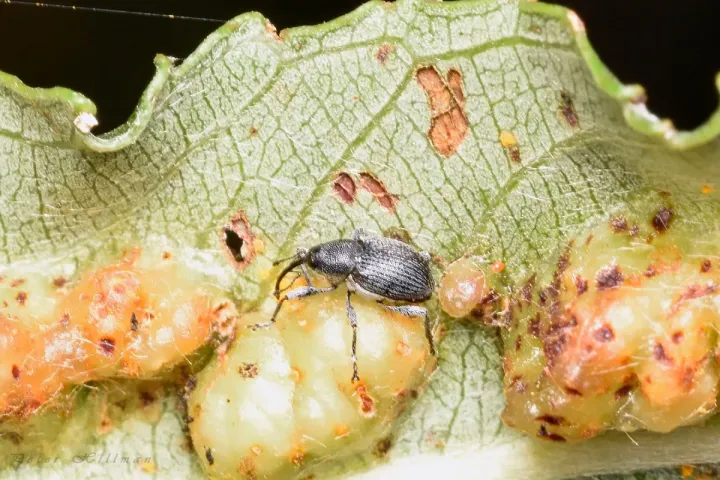
The willow weevil (Curculio salicivorus) belongs to the large family Curculionidae within the order Coleoptera. This small beetle is easily identified by its long, curved rostrum (snout), which is typical of the genus Curculio.
Adult beetles generally measure between 4 to 6 mm in length. Their bodies are typically covered in dense, fine scales that provide a brownish-grey coloration, allowing them to blend perfectly with the bark and foliage of their host willow trees.
The larval stage consists of a legless, C-shaped grub that is whitish in color with a dark, sclerotized head capsule. Larvae are specialized for internal feeding, developing inside the stems or catkins of the host plant.
Behaviorally, the adults are elusive; they exhibit thanatosis (playing dead) when disturbed, which makes them difficult to spot during routine inspections of willow plantations or ornamental gardens.
The species has a distinct preference for high-moisture environments where its host plants, various species of Salix, thrive and provide the necessary conditions for larval development.
What it damages
Adult willow weevils cause damage by feeding on young leaves, resulting in small, irregular holes. While this rarely kills the tree, it significantly diminishes the aesthetic appeal of ornamental willow varieties.
The primary damage, however, is caused by the larvae, which bore into young shoots, leaf buds, or catkins. This internal feeding disrupts the plant's vascular system, leading to stunted growth and branch deformation.
Heavy infestations can cause premature dropping of catkins and leaves, which reduces the tree's vigor and its ability to photosynthesize effectively throughout the growing season.
By creating wounds and pathways inside the stems, the weevil facilitates the entry of fungal pathogens, often leading to secondary infections that can cause localized dieback.
In commercial willow nurseries, the impact is more pronounced, as larval tunneling in the terminal leader can destroy the vertical growth, necessitating corrective pruning and causing economic loss.
When it appears
Adults emerge from their overwintering sites in the soil or leaf litter in early spring, synchronized with the onset of bud break and the beginning of sap flow in willow trees.
Mating occurs shortly after emergence, followed by the female using her snout to drill deep holes into the plant tissue, where she deposits individual eggs to ensure the protection of the offspring.
Larval development takes place during the summer months. As the larvae grow, they consume the internal tissues, protected from most environmental threats and many contact pesticides.
Pupation typically occurs in the late summer, either inside the damaged plant tissue or by dropping into the soil, where the insects prepare for the transformation into the adult stage.
The life cycle is generally completed in one year (univoltine). The new generation of adults may emerge in late summer to feed briefly before seeking shelter for the winter months.
Signs of infestation
Early symptoms appear as "shot-hole" patterns on fresh spring foliage, indicating the presence of adults feeding at the canopy level.
The sudden wilting or browning of catkins during the late spring serves as a key indicator that larvae are actively feeding within these reproductive structures.
A fine, brownish "frass" (larval excrement) appearing at the entry holes of stems or branches is a clear sign that a tunnel is being excavated by a developing larva inside.
Malformed or "hooked" tips of young shoots are symptomatic of larval tunneling in the terminal bud, which interferes with the apical dominance of the branch.
In severe cases, you may notice clusters of shriveled, discolored leaves at the end of branches, reflecting the disruption of nutrient and water transport due to larval boreholes.
Control measures
Cultural control is highly effective: promptly prune and burn any infested shoots or withered catkins before the larvae can complete their development and exit the plant.
Tilling the soil around the base of the trees in late autumn can expose overwintering adults to predatory birds and harsh winter conditions, reducing the population for the following spring.
Chemical control should be timed to coincide with the early spring emergence of adults, focusing on systemic insecticides that provide protection during the critical egg-laying period.
Biological control options, including the application of entomopathogenic nematodes or fungi to the soil, can be employed in high-value areas to suppress the larval stage as they prepare for pupation.
- Monitor trees regularly during the spring growth flush for adult activity.
- Maintain plant health through proper watering and fertilization to improve resistance.
- Implement trap trees or pheromone lures if local infestation levels become economically damaging.
Taxonomy
- Latin name
- Curculio salicivorus
- Order
- Coleoptera (beetles)
- Family
- Curculionidae
- EPPO code
- BALBSA
Discussion
No discussions yet — be the first.