
Dieckmann's nut weevil
Curculio dieckmanni
Description
How to identify
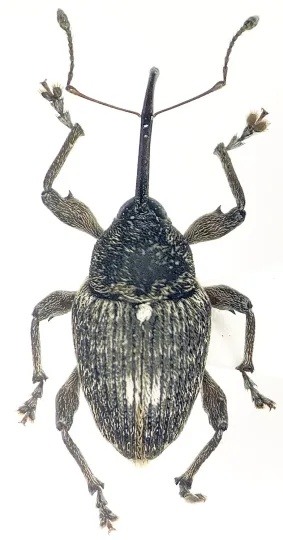
Dieckmann's nut weevil (Curculio dieckmanni) is a beetle species within the Curculionidae family, notable for its extremely long, slender snout. This specialized mouthpart allows the female to penetrate the hard shell of developing nuts to deposit eggs inside the kernel.
Adult beetles are generally brown or grey, often covered with dense scales that provide effective camouflage against the bark of their host trees. Larvae are typically C-shaped, legless, and creamy-white with a darker head capsule, spending their entire life cycle feeding within the nut.
What it damages
This pest primarily attacks various nut species, with a notable preference for Manchurian walnuts. The damage is severe, as the larvae consume the developing nut kernel, making it completely inedible and reducing the harvest quality to almost zero.
Beyond the damage caused to the fruit, adult weevils feed on leaves and young shoots. While this rarely kills a mature tree, chronic infestation can significantly stunt growth, reduce overall plant vigor, and increase susceptibility to secondary infections.
When it appears
The life cycle begins in spring when overwintering adults emerge from the soil. This emergence is usually synchronized with the host tree's bud break and the initial development of young nuts, which provide the essential resource for the next generation.
Egg-laying activity peaks during the early stages of nut development. Once the larvae finish feeding inside the nut, they exit through a small hole to burrow into the soil, where they either pupate or overwinter in a larval chamber depending on the environmental conditions.
Signs of infestation
The most distinctive symptom of an infestation is the presence of small, perfectly round holes in the shells of young nuts. These marks are entry points created by the female weevil, which often lead to localized necrosis or sap discharge around the affected area.
Premature nut drop is another clear indicator of larval activity. If these fallen nuts are inspected, they frequently exhibit tunneling and internal decay, confirming the presence of Curculio dieckmanni larvae feeding on the developing fruit.
Control measures
Sanitation is a critical control measure, involving the rigorous removal and destruction of all infested fallen nuts before larvae can emerge and move into the soil. Deep cultivation of the soil under the tree canopy in late autumn can destroy pupation chambers.
- Monitor adult populations using trap trees or visual inspection in spring.
- Apply systemic or contact insecticides during the pre-oviposition period.
- Encourage natural predators and parasitoids within the orchard ecosystem.
- Use physical barriers or bagging for high-value nut trees in small gardens.
Taxonomy
- Latin name
- Curculio dieckmanni
- Order
- Coleoptera (beetles)
- Family
- Curculionidae
- EPPO code
- CURCDI
Discussion
No discussions yet — be the first.