
Crossotarsus bonvouloiri
Crossotarsus bonvouloiri
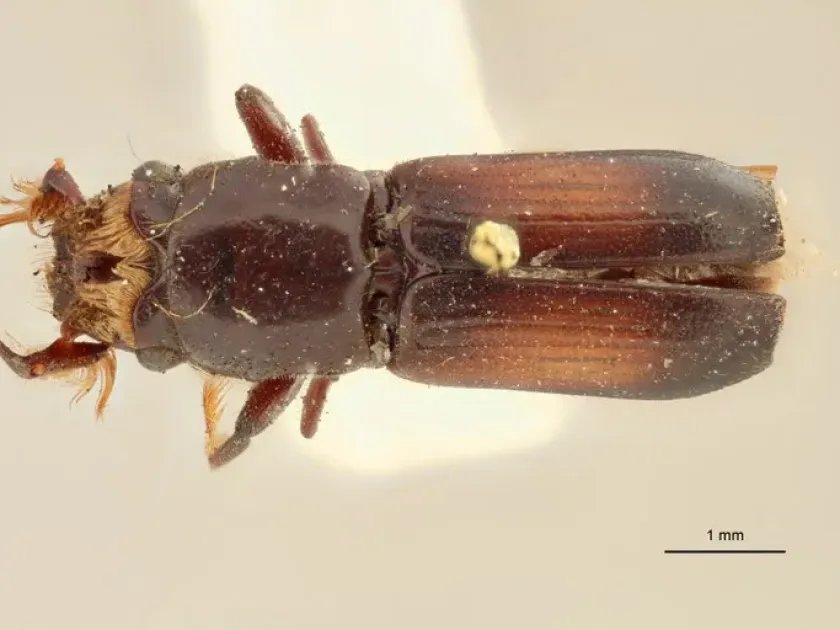
Description
How to identify
Crossotarsus bonvouloiri is a species of beetle belonging to the order Coleoptera and the family Curculionidae (subfamily Scolytinae).
These insects are small, cylindrical beetles specifically evolved to live and reproduce within the dense tissue of tree trunks.
The adults are typically dark brown or black, providing excellent camouflage while moving through galleries in the wood.
Morphologically, they possess elongated bodies and specialized elytra structures designed to push wood dust out of their tunnels efficiently.
The larvae are white, legless, and equipped with strong mandibles capable of boring into even the hardest types of wood.
What it damages
The primary hosts of this beetle are various deciduous tree species found in tropical and subtropical forest ecosystems.
The pest typically attacks weakened, stressed, or freshly felled trees, posing a significant risk to logging and timber industries.
Beetles penetrate deep into the trunk, creating complex networks of galleries that traverse both the sapwood and the heartwood.
The damage caused includes both structural destruction of the timber and the introduction of pathogenic fungi that lead to wood rot.
High levels of infestation significantly decrease the commercial value of lumber, rendering it unusable for high-quality carpentry.
Signs of infestation
The most prominent sign of infestation is the appearance of tiny entry holes in the bark of the host tree.
Small piles of frass, resembling fine sawdust, are often visible around the entry holes, indicating active gallery construction.
If the tree is attacked while still partially alive, one might observe sap exudation at the sites of beetle penetration.
Peeling away the bark reveals clear entrance canals that lead directly and perpendicularly into the deeper layers of the wood.
Massive infestations result in a porous internal structure of the trunk, leading to structural failure and the eventual death of the tree.
Control measures
The primary method of control involves systematic sanitary logging and the prompt removal of infested timber from forest stands.
Preventative measures include avoiding long-term storage of debarked or freshly cut timber in areas known to harbor beetle populations.
Pheromone traps serve as an effective tool for monitoring population levels and determining the appropriate timing for intervention.
Chemical treatments are generally restricted to timber yards and are often limited in efficacy due to the beetle's deep penetration.
- Regular forest pathological monitoring
- Rapid processing of felled logs
- Maintenance of site hygiene
Taxonomy
- Latin name
- Crossotarsus bonvouloiri
- Order
- Coleoptera (beetles)
- Family
- Curculionidae
- EPPO code
- CROSBO
Discussion
No discussions yet — be the first.