
Birch sawfly
Craesus septentrionalis
Description
How to identify
The birch sawfly (Craesus septentrionalis) is a member of the Hymenoptera order, specifically the Tenthredinidae family. Adult insects typically reach 9–11 mm in length and feature a black body with distinctive pale markings on their legs, making them recognizable to those familiar with sawfly morphology.
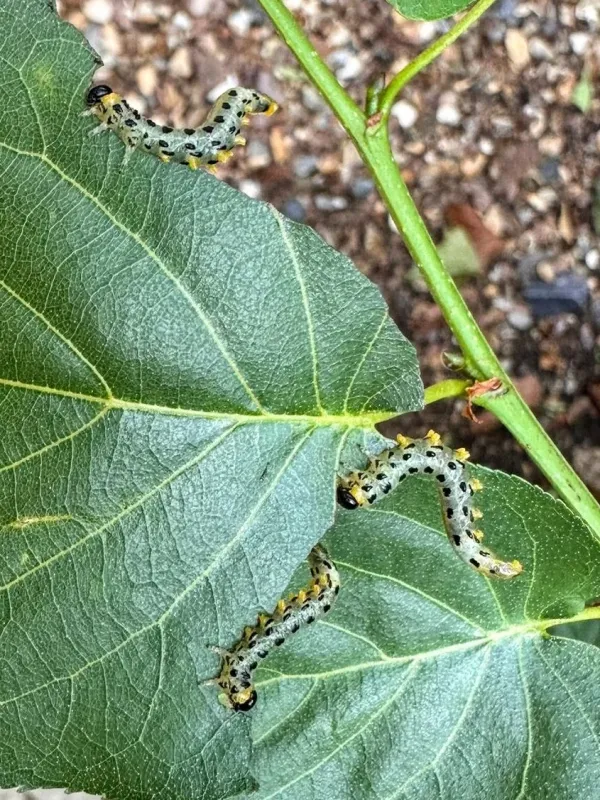
The larvae, often referred to as false caterpillars, are the most prominent stage of this pest. They grow to approximately 20–25 mm in length and possess a characteristic appearance: a greenish-grey dorsal side with lighter flanks, decorated with a series of distinct black spots arranged in segments along the body.
A fascinating biological feature of this species is their gregarious behavior when threatened. If disturbed, the larvae synchronize their movements, lifting the posterior ends of their bodies into the air to deter predators and birds.
The life cycle generally consists of one or two generations per year. The insect overwinters as a mature larva or pupa within a tough, dense cocoon located in the soil under the host tree, providing excellent protection against environmental fluctuations.
Adult emergence typically aligns with the onset of the birch leaf-flush in late spring, ensuring that emerging larvae have immediate access to fresh, tender foliage for rapid development.
What it damages
While birch trees (Betula) are the primary host for this sawfly, it is also known to infest alder, willow, and occasionally hazel or poplar, making it a generalist feeder within the local deciduous forest ecosystem.
Damage is exclusively caused by the larvae, which possess robust mandibles for chewing. They feed in groups, typically starting at the margins of the leaves and consuming the tissue until only the leaf skeleton or nothing at all remains.
In cases of high population density, these pests are capable of complete defoliation of the tree. This loss of canopy cover mid-season is a significant stress factor that hampers the tree's overall photosynthetic capacity.
Chronic infestation, occurring over several consecutive seasons, significantly weakens the tree's health. This makes the host more susceptible to secondary infections, bark beetles, and reduced growth rates that impact the tree's long-term vitality.
Young trees are particularly vulnerable. A single year of total defoliation can deplete the starch reserves stored in the roots, potentially leading to the death of the tree if it is already facing stress from drought or nutrient deficiency.
When it appears
The first generation of adults emerges in late May or early June, corresponding precisely with the optimal temperature conditions and the availability of fresh foliage on the host trees.
Larval feeding for the first generation occurs primarily throughout June and July. During this peak activity window, gardeners should monitor the undersides of leaves for clusters of young larvae, which are most susceptible to treatment at this stage.
A second generation may appear in late summer, particularly in regions with longer growing seasons. This secondary infestation can continue the pressure on the trees until the end of August.
Pupation takes place in the soil, where the larvae construct their cocoons. This stage represents a period of dormancy or transition, during which the insect remains hidden from most surface-level control methods.
Early detection is the key to effective management. Regular inspections starting in late spring are essential to prevent the expansion of the population and mitigate the spread of the sawfly across the garden or nursery.
Signs of infestation
The most reliable sign of a birch sawfly presence is the pattern of defoliation. Larvae graze on leaf edges, creating crescent-shaped notches that eventually expand into total leaf consumption, leaving behind a ragged appearance.
The presence of larval excrement, which resembles small, dark, granular pellets scattered on the foliage below the feeding site, provides clear evidence of active colonization and feeding damage.
Observing a group of larvae on a branch is common due to their social feeding behavior. Any movement or vibration will trigger the characteristic defensive posturing where they raise their tails in unison.
If left unchecked, the foliage will show signs of browning and early wilting. This damaged canopy reduces the aesthetic value of the tree and serves as a precursor to premature leaf drop by late summer.
- Marginal leaf grazing creating distinct notches.
- Grouped feeding colonies of larvae.
- Dark granular frass on remaining leaf surfaces.
- Synchronized defensive movement when disturbed.
- Premature canopy thinning and leaf drop.
Control measures
Manual control is highly effective for smaller, manageable trees. Since the larvae congregate in groups, one can simply prune the affected branches or shake the larvae onto a sheet and dispose of them, preventing the spread.
Cultivating the soil under the canopy in late autumn is a simple yet effective cultural control method. This process destroys the overwintering cocoons and exposes them to predators and cold temperatures, significantly reducing the next season's population.
For large-scale infestations, chemical control using systemic or contact insecticides may be necessary. Products targeted at caterpillars and sawflies are highly effective if applied as soon as the first signs of larval activity are observed.
Biological control methods, such as utilizing products containing Bacillus thuringiensis, offer an environmentally friendly alternative that targets the larvae specifically without disrupting the local balance of beneficial insects and pollinators.
Promoting local bird populations and other natural predators, such as parasitic wasps, is an excellent long-term strategy. These natural enemies often regulate sawfly numbers, keeping them below the economic damage threshold.
Taxonomy
- Latin name
- Craesus septentrionalis
- Order
- Hymenoptera
- Family
- Tenthredinidae
- EPPO code
- CROESE
Discussion
No discussions yet — be the first.