
Birch sawfly
Craesus latitarsus
Description
How to identify
The birch sawfly (Craesus latitarsus) is a member of the Tenthredinidae family in the order Hymenoptera. The adult insect has a dark, metallic-looking body and is typically 8–10 mm long.
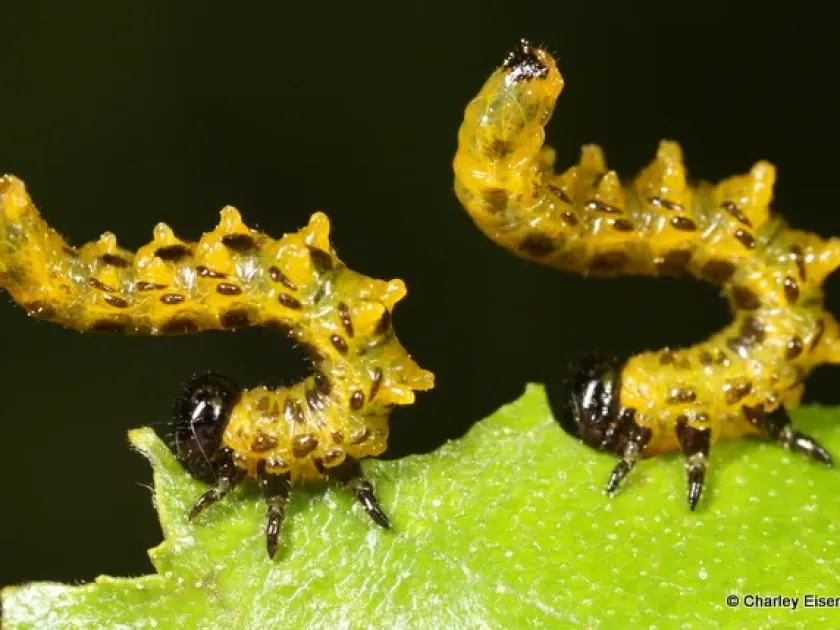
The larvae are known for their distinct greenish bodies covered with black spots. They are often found feeding together in large groups on the leaves of host trees.
Adults possess transparent wings with complex venation and are most active during warm, sunny days. They prefer to lay eggs within the leaf tissue, which then hatch into larvae.
The lifecycle follows a complete metamorphosis: egg, larva, pupa, and adult. They typically overwinter as pre-pupae inside cocoons buried within the soil.
Generally, one generation develops per year, although favorable warm weather can sometimes lead to the emergence of a partial second generation in late summer.
What it damages
The primary host for Craesus latitarsus is the birch tree. Larvae are highly voracious and feed in clusters, which allows them to defoliate entire branches quickly.
Young trees are particularly vulnerable, as repeated defoliation stunts growth and leaves them weakened against harsh winters or subsequent opportunistic diseases.
Older trees are usually more resilient, but severe outbreaks can still cause visible thinning of the canopy, reducing the tree's overall aesthetic and health.
The feeding process results in skeletonization of the leaves, where only the veins remain. This significantly limits the tree's photosynthetic capacity.
Continuous damage over several years can lead to the dieback of branches and, in extreme cases, the overall decline of the specimen in the landscape.
Signs of infestation
The most obvious sign of an infestation is the presence of gregarious larvae feeding on the edges of birch leaves. They are hard to miss due to their cluster behavior.
Leaf skeletonization is a hallmark of this pest. You will notice that the leaf tissue between the veins is completely removed, leaving a fine lace-like structure.
Frass, or insect droppings, appears as fine dark pellets on the ground or on the leaves beneath the feeding site, indicating an active colony above.
When disturbed, the larvae perform a unique defensive display by arching their bodies upwards in unison, a behavior characteristic of this specific sawfly species.
Thinning of the foliage on specific branches in mid-season is often the first visible indicator that a colony has successfully established itself.
Control measures
For small ornamental birch trees, hand-picking the larvae is a simple and effective control method. Since they feed in groups, they can be removed in large numbers at once.
Biological insecticides, such as those containing Bacillus thuringiensis, are highly effective against sawfly larvae while remaining safe for the surrounding environment.
Chemical control involving systemic insecticides can be used if an outbreak becomes unmanageable, though it should be applied carefully to avoid harming beneficial insects.
Cultivating the soil around the base of the tree in late autumn helps disrupt the overwintering pupae, exposing them to cold weather and natural predators.
Encouraging natural enemies, such as insectivorous birds and parasitic wasps, can help suppress sawfly populations naturally without the need for chemical intervention.
Taxonomy
- Latin name
- Craesus latitarsus
- Order
- Hymenoptera
- Family
- Tenthredinidae
- EPPO code
- CROELA
Discussion
No discussions yet — be the first.