
Reed moth
Cosmopterix scribaiella
Description
How to identify
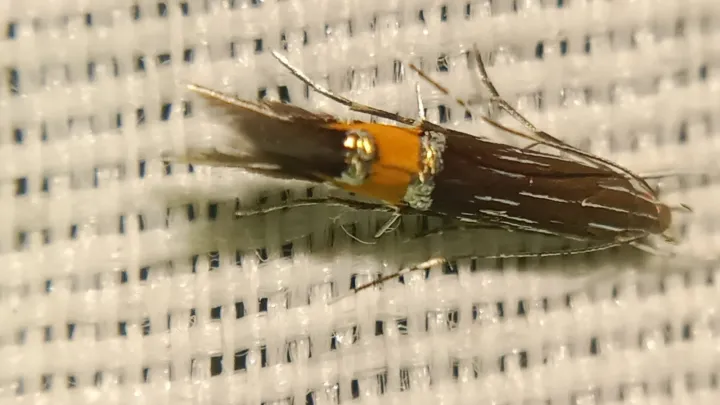
The Reed moth (Cosmopterix scribaiella) is a small lepidopteran belonging to the family Cosmopterigidae, often called the "glorious micro-moths". It is characterized by narrow, pointed wings with a vivid pattern of metallic streaks and spots.
Adult moths have a wingspan of approximately 10–12 mm. Their dark, iridescent coloration provides excellent camouflage against the backdrop of reed leaves and stems during daylight hours.
As nocturnal insects, they are rarely seen during the day. Most of their life cycle is hidden from view, occurring within the internal tissues of their host plant, which is typically the common reed (Phragmites australis).
The larvae are small, slender, and pale green or yellowish with a dark head. They possess specialized mouthparts designed to tunnel through the parenchyma of the leaves, creating distinct mining patterns.
This species is highly host-specific, meaning its distribution is limited to habitats where reed beds are present. Their population dynamics are deeply influenced by the health and density of these reed stands.
What it damages
The primary damage caused by the Reed moth involves the destruction of leaf tissue. The larvae feed internally, creating long, narrow, and often translucent tunnels known as "mines" within the leaf blades.
These mines disrupt the plant's ability to conduct photosynthesis efficiently. As a result, the affected leaves may exhibit chlorosis, turn yellow, and eventually die off prematurely if the infestation is severe.
In cases of high pest density, multiple larvae can inhabit a single leaf, leading to extensive tissue damage. This weakens the entire plant, making it more susceptible to environmental stressors and pathogens.
While the Reed moth rarely kills the entire reed plant, it significantly reduces the overall vigor of the reed bed. This is particularly problematic in areas where reeds are cultivated for commercial or environmental purposes.
The damaged leaves lose their structural integrity and aesthetic value. For producers of reed-based building materials, this infestation can lead to a decrease in the quality and durability of the harvest.
When it appears
The life cycle of the Reed moth is perfectly adapted to the growing season of the common reed. Depending on regional climate conditions, the species typically produces one or two generations per year.
Adults emerge in the spring once temperatures have consistently risen. After mating, females lay eggs on the leaves, usually near the midrib or at the base of the leaf, providing immediate access for emerging larvae.
Larval feeding is most intense during late spring and throughout the summer months. During this period, the characteristic mines become visible as the larvae consume the leaf interior.
Pupation occurs within the leaf mine, where the larva creates a chamber for protection. The pupal stage is relatively short, allowing the next generation to emerge quickly during the peak growing season.
The species overwinters as either a late-stage larva or a pupa, tucked away inside the hollow stalks of the dry reeds. This protective habit ensures survival against harsh winter frosts until spring returns.
Signs of infestation
The most reliable sign of a Reed moth infestation is the appearance of pale, longitudinal stripes on the reed leaves. These are the mines created by the larvae as they tunnel through the tissue.
Close inspection of these mines often reveals small, dark specks, which are the larvae's frass (excrement). This sign is crucial for distinguishing the moth's activity from other leaf-damaging pests or diseases.
Severely infested leaves tend to curl, lose their vibrant color, and eventually wither at the tips. If the infestation is widespread, the entire reed bed may appear thin, discolored, or patchy.
Observant gardeners or farmers can sometimes spot the dark silhouette of the larva inside the leaf tunnel by holding the leaf up against the sunlight, confirming an active infestation.
- Translucent longitudinal lines (mines) on leaves
- Small dark frass particles inside the leaf tunnels
- Yellowing and premature drying of leaf tips
- General weakening and thinning of the reed stand
Control measures
The most effective management strategy is cultural: removing and burning infested reed debris in late autumn or early spring. This eliminates the larvae and pupae hibernating in the dead stalks.
Chemical control, if necessary, requires the use of systemic insecticides that can penetrate leaf tissues to reach the larvae hidden within the mines. Application must be timed to coincide with the larval hatch.
Biological control, such as encouraging natural parasitoids (tiny wasps), can help regulate populations. These natural enemies often enter the leaf mines to prey on the larvae, providing a sustainable solution.
Monitoring using pheromone traps or light traps helps in identifying the emergence of adults. This allows for precision timing of interventions, reducing the need for broad-spectrum pesticide use.
Maintaining the overall health of the reed stand through proper water management is also essential. Healthy, vigorous plants are more capable of tolerating and recovering from limited larval damage.
Taxonomy
- Latin name
- Cosmopterix scribaiella
- Order
- Lepidoptera (butterflies)
- Family
- Cosmopterigidae
- EPPO code
- COSXSC
Discussion
No discussions yet — be the first.