
Cosmopterix attenuatella
Cosmopterix attenuatella
Description
How to identify
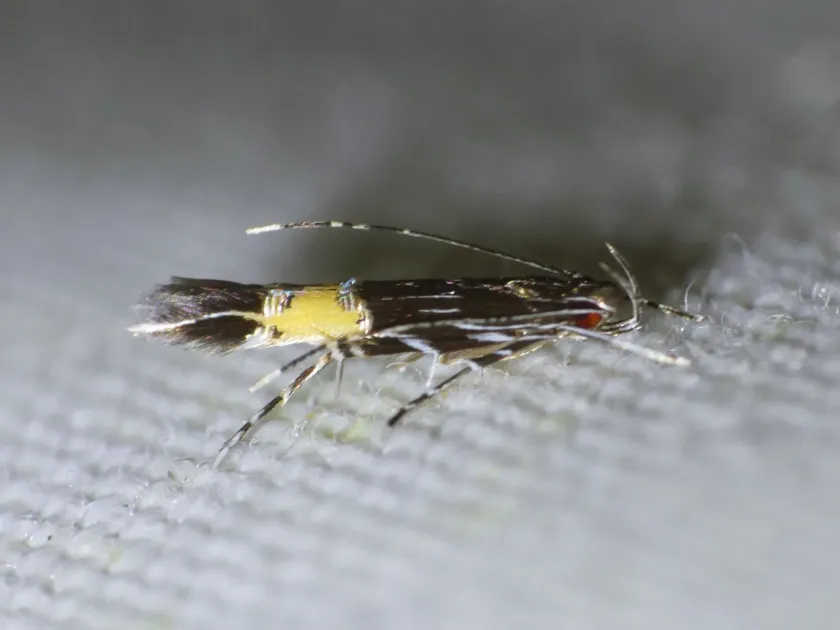
Cosmopterix attenuatella is a species of moth belonging to the family Cosmopterigidae (Cosmet moths) in the order Lepidoptera. The adults are small, slender moths characterized by very narrow, pointed wings.
The forewings often exhibit a distinct metallic sheen and a pattern of light-colored streaks or spots. When at rest, the moth keeps its wings folded closely along its body, giving it a needle-like appearance.
The larvae are specialized leaf miners. They possess a soft, cylindrical body that is adapted to living within the narrow space between the epidermal layers of a plant leaf.
The life cycle undergoes complete metamorphosis. Depending on the geographical region and local climate, the species may produce several generations per year.
Adults are generally nocturnal or crepuscular, making them less visible during daylight hours compared to the damage caused by their larvae.
What it damages
The primary hosts of Cosmopterix attenuatella are various plants within the family Poaceae, including critical crops like rice, millet, and maize.
The larvae feed on the parenchyma tissue between the upper and lower leaf surfaces, creating characteristic tunnels known as mines. This feeding behavior destroys photosynthetic tissue.
Severe infestations can lead to significant leaf chlorosis, stunted growth, and a reduction in the overall yield potential of the infected crop fields.
The damage is typically localized but can spread rapidly across a field if environmental conditions, such as temperature and humidity, favor the pest's reproduction.
While often considered a secondary pest, it can reach economic thresholds in specific regions where host plants are densely cultivated.
Signs of infestation
The most visible sign of infestation is the presence of mines on the leaves. These mines appear as narrow, translucent, or whitish lines running parallel to the leaf veins.
Dark frass (larval waste) is often deposited inside the mines, appearing as small black specks within the otherwise clear tunnel path.
Leaves that are heavily mined may turn yellow, wither, or exhibit distortion as the leaf structure collapses due to the larval feeding.
Exit holes can sometimes be observed on the leaf surface, indicating that the larvae have finished their development and are ready to pupate elsewhere.
Field monitoring during the growth season is essential to detect the early arrival of adult moths or the emergence of the first leaf mines.
Control measures
Effective management includes integrated pest management strategies, starting with sound agronomic practices like thorough plowing to destroy pupating sites in the soil.
Weed management is a crucial preventive step, as many wild grasses serve as alternative hosts for the moth, allowing populations to survive outside of crop seasons.
When chemical intervention is necessary, systemic insecticides are the most effective because they can penetrate the leaf tissue to reach the mining larvae.
Application timing is critical; treatments should be aligned with the peak flight period of adult moths to prevent egg-laying and subsequent damage.
Biological control through the preservation of natural predators and parasitoids can also play a significant role in keeping population levels below the economic threshold.
Taxonomy
- Latin name
- Cosmopterix attenuatella
- Order
- Lepidoptera (butterflies)
- Family
- Cosmopterigidae
- EPPO code
- COSXAT
Discussion
No discussions yet — be the first.