
Linden gall midge
Contarinia tiliarum
Description
How to identify
The linden gall midge (Contarinia tiliarum) belongs to the Cecidomyiidae family, order Diptera. It is a tiny insect, resembling a small gnat, with a wingspan of approximately 2–3 mm.
Adults have a fragile body that is yellowish-brown or grayish in color. Their life cycle is tightly synchronized with the phenological development of linden trees, making them highly specialized pests.
The larvae are legless, spindle-shaped, and pale yellow or white. The larval stage is the one responsible for causing damage to the host plant's tissues.
Pupation primarily occurs in the soil or in leaf litter, which makes the insect difficult to control during this stage. Females possess an ovipositor used to insert eggs directly into the soft tissues of young leaves.
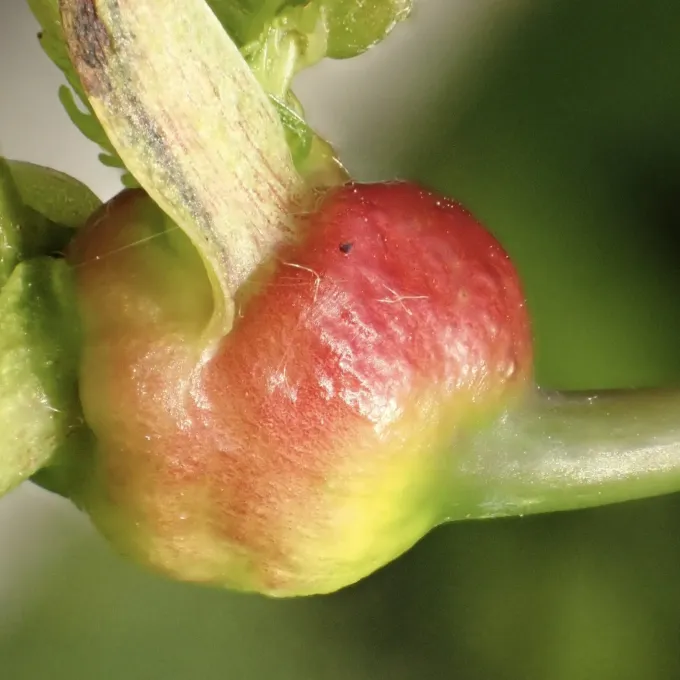
A crucial morphological sign of their presence is the formation of specific growths, or galls, on the leaves where the insects develop within a protected environment.
What it damages
The primary host for this species is the linden tree (Tilia), mainly the small-leaved lime. The gall midge affects only young, actively growing plant tissues.
While the pest rarely kills the tree outright, it causes severe deformation of leaf blades and petioles, which significantly reduces the tree's overall photosynthetic capacity.
Mass infestations lead to premature yellowing and leaf drop, which is particularly detrimental to young saplings in nurseries and urban parklands.
Damaged tissues become entry points for secondary infections, including various fungal diseases that thrive in the compromised plant areas.
Heavy infestations negatively affect the aesthetic appearance of linden trees, which is a major concern in landscape design and recreational forestry.
When it appears
The emergence of adult midges coincides with the budding and active shoot growth period of linden trees in late spring.
During this time, females actively lay eggs in the petioles or veins of young leaves, triggering the formation of galls. The development cycle of one generation takes several weeks.
The pest typically has one generation per year, though favorable weather conditions may allow for a partial second generation during the summer.
By late summer, the larvae leave the galls and enter the soil to overwinter, where they pupate in cocoons until the following spring.
Temperature and humidity levels during the spring season are the primary factors that determine the population density of the gall midge in any given year.
Signs of infestation
The primary sign of infestation is the formation of distinct galls—swellings or growths—on the petioles, veins, or young leaf blades.
Galls are typically elongated or rounded, often displaying a reddish, yellow, or green color that contrasts with the surrounding leaf tissue.
- Deformation and curling of leaf blades.
- Visible growths on leaf petioles.
- Premature yellowing and leaf drop during summer.
- Stunted growth of young linden shoots.
Upon inspecting a gall, one can often find one or more white larvae feeding on plant sap inside this protective chamber.
Visual inspection of the canopy during May and June allows for the early detection of infestation hotspots and the initiation of control measures.
Control measures
The most effective method for managing the linden gall midge is through cultural practices aimed at destroying the insect's overwintering stages.
Collecting and disposing of fallen leaves in autumn significantly reduces the overwintering population in the soil and leaf litter.
Cultivating or tilling the soil around the base of the trees in autumn or early spring helps destroy the cocoons found in the topsoil layer.
In nurseries where infestations are severe, systemic insecticides may be applied during the period when larvae are hatching from eggs.
Biological control, such as encouraging natural predators and parasitoid wasps, also contributes to keeping the gall midge population under control.
Taxonomy
- Latin name
- Contarinia tiliarum
- Order
- Diptera (flies)
- Family
- Cecidomyiidae
- EPPO code
- CONTTI
Discussion
No discussions yet — be the first.