
Pear midge
Contarinia pyrivora
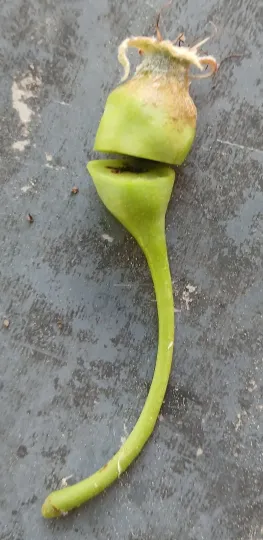
Description
How to identify
The pear midge (Contarinia pyrivora) is a small dipteran insect belonging to the Cecidomyiidae family. Adult midges are delicate, mosquito-like flies with a body length of about 3–4 mm.
The life cycle involves a single generation per year. The insect overwinters as fully grown larvae in cocoons located in the soil at depths of up to 20 cm under the host trees.
Pupation occurs in early spring. Adult emergence is precisely timed with the blossoming period of pear trees, allowing the females to lay their eggs directly into the flower buds.
The larvae are small, white, and legless. Upon hatching, they migrate into the developing fruitlet, where they live in a group and consume the inner tissues.
After completing their development, the larvae exit the fruits by rupturing the epidermis and drop to the ground to enter the soil for pupation, completing their annual cycle.
What it damages
The primary and almost exclusive host for this pest is the pear tree (Pyrus species). It causes severe economic damage in orchards by targeting the reproductive structures.
The larvae induce abnormal growth in the infested fruitlets. Infested fruits develop much faster than healthy ones, becoming visibly bloated and asymmetrical.
This rapid, uneven growth results in the total destruction of the pear crop. The fruits lose their marketability and become distorted and unappealing.
The internal consumption of the fruit tissue by larvae leads to the formation of central cavities filled with frass, often encouraging rot due to secondary fungal infections.
In cases of high infestation, the pear midge can lead to the loss of almost the entire season's yield, significantly impacting orchard productivity.
When it appears
The adult emergence coincides with the bud burst and white bud stages of the pear tree, usually occurring in late April or throughout May depending on the local climate.
Egg-laying activity is concentrated during the blossom stage, when females use their long ovipositors to deposit eggs into the flowers.
The larval stage is spent inside the growing fruitlet throughout late May and early June, coinciding with the period of rapid fruit expansion.
In mid-June, following initial summer rains, the mature larvae typically exit the infested pears to burrow into the soil, leaving characteristic emergence holes.
The pest remains in the soil as larvae in cocoons throughout the rest of the summer, autumn, and winter months.
Signs of infestation
The first sign of an infestation is the premature and rapid swelling of fruitlets, which stand out significantly against the size of normal, healthy fruitlets.
Infested pears exhibit distorted, lumpy shapes. They often appear to have "shoulders" or bulges due to the irregular development caused by larval feeding.
Cutting open these suspicious fruitlets in late May reveals the presence of numerous small, creamy-white larvae inside the central core area.
In June, the appearance of dark, cracked spots or small exit holes on the surface of the fruit indicates that the larvae have already left the fruit.
Massive June fruit drop is a classic indicator of a pear midge outbreak. These fallen fruits are usually visibly deformed and soft to the touch.
Control measures
- Regular collection and destruction of infested fallen fruitlets before the larvae have a chance to escape into the soil.
- Cultivation and deep tilling of the soil under the tree canopy in autumn and spring to destroy overwintering cocoons.
- Application of systemic insecticides at the "white bud" stage to control adults before egg-laying occurs.
- Covering the ground beneath trees with landscape fabric or plastic during the spring to prevent emerging midges from reaching the trees.
- Monitoring pest populations using pheromone traps to time the interventions accurately.
Taxonomy
- Latin name
- Contarinia pyrivora
- Order
- Diptera (flies)
- Family
- Cecidomyiidae
- EPPO code
- CONTPY
Discussion
No discussions yet — be the first.